Bangladesh vs. Greece: Similar Land, 17x the People
Bangladesh covers 148,460 km² to Greece's 131,957 km², about 13% larger. Yet Bangladesh holds nearly 17 times Greece's population.
Map2Maps Team
Bangladesh is the global reference point for population density at scale, and this comparison shows exactly why. On land barely bigger than Greece's, it holds roughly 17 times as many people.
Key Takeaways: - Bangladesh covers 148,460 km² against Greece's 131,957 km², about 13% larger - Bangladesh holds an estimated 174 million people to Greece's 10.4 million — nearly 17 times as many - Bangladesh's population density is more than 14 times Greece's
How Do Bangladesh and Greece Compare in Size?
Fairly close. Bangladesh covers 148,460 km² (57,320 sq mi) and Greece covers 131,957 km² (50,949 sq mi) (CIA World Factbook, 2026), a gap of roughly 16,500 km², about 13% in Bangladesh's favor — similar enough that the real story here isn't the land at all.
Drag Bangladesh onto Greece on the interactive map. The land nearly matches; the population living on it does not.
The Density Gap That Defines Bangladesh
Bangladesh holds an estimated 174.4 million people as of 2025 (CIA World Factbook, 2025 est.); Greece holds roughly 10.4 million. That is nearly 17 times as many people on only 13% more land — Bangladesh's population density works out to about 1,175 people per km², among the highest of any country of significant size anywhere on Earth. Greece's density, by contrast, is around 79 per km², unremarkable by European standards.
To put Bangladesh's density in perspective: it packs a population larger than Russia's — the world's largest country by area — onto a footprint only slightly bigger than the US state of Iowa. Almost the entire country sits on the low-lying delta of the Ganges, Brahmaputra, and Meghna rivers, among the most fertile — and most flood-prone — land on Earth.
Two Economies Closer Than the Population Gap Suggests
Despite the enormous population gap, the two economies are surprisingly close in absolute size: Bangladesh's nominal GDP runs about $458 billion (IMF, 2025 estimate); Greece's is roughly $308 billion (IMF, 2025 estimate) — Bangladesh's economy is actually the larger of the two by total output, driven substantially by its garment export industry, one of the world's largest.
GDP per capita tells the real story, though: Greece's works out to roughly $29,600 per person; Bangladesh's to around $2,625, a gap of more than 11 to 1. Bangladesh's economy is large in aggregate because of sheer population scale, not because individual output rivals Greece's.
Compare Any Country on Earth
Save unlimited comparisons and return to them whenever you need them, with priority support included.
Terrain and Climate
Bangladesh is almost entirely a river delta, among the largest and most fertile on Earth, criss-crossed by the Ganges, Brahmaputra, and Meghna rivers and their countless distributaries. That fertility supports the population density, but the same flat, low-lying geography makes the country acutely vulnerable to flooding, cyclones, and rising sea levels — a large share of the country sits under 10 m above sea level.
Greece's terrain is the opposite: mountainous and fragmented, with roughly 80% of the mainland covered by hills or mountains, plus over 6,000 islands and islets (about 227 inhabited), scattered across the Aegean and Ionian seas. Mount Olympus (2,917 m), legendary home of the Greek gods, is the country's highest point.
Interactive Exploration
Explore this comparison on our interactive map tool
Explore Interactive MapOverlay the two and the land areas nearly match — the story here isn't the outline, it's what's packed inside it.
Fun Facts
Bangladesh:
- One of the world's most densely populated countries at any significant scale
- The Sundarbans, shared with India, is the largest mangrove forest on Earth
- One of the world's largest garment exporters, behind only China
- The delta it sits on is fed by three of Asia's largest rivers
Greece:
- Birthplace of democracy, Western philosophy, and the Olympic Games
- Has over 6,000 islands and islets, of which about 227 are inhabited
- Home to more archaeological sites per capita than almost any other country
- Mount Olympus, at 2,917 m, was considered the home of the gods in Greek mythology
Conclusion
Bangladesh and Greece occupy almost the same amount of land, a genuine coincidence given how differently each is used. Bangladesh's population density, nearly 17 times Greece's on only slightly more territory, is one of the starkest numbers on this entire site — and a useful anchor for understanding why Bangladesh is so often cited as the world's benchmark for population pressure at national scale.
Sources and method
- Country areas and Bangladesh population: CIA World Factbook
- Greece population: World Bank Open Data
- GDP estimates: International Monetary Fund
- Boundary geometry: Natural Earth
Method: boundaries come from Natural Earth 3.3.0 (1:50m). Areas are computed with Turf's geodesic area function over the polygon geometry, so they do not depend on the Web Mercator projection used for display. Figures include inland water and follow each source's treatment of disputed boundaries.
Note: GDP figures are 2025 IMF nominal estimates and can vary by a few percent between sources for the current year.
Figures checked 22 September 2026.
Frequently Asked Questions
Is Bangladesh bigger than Greece?
Why does Bangladesh have such a high population density?
Is Bangladesh's economy bigger than Greece's?
How many islands does Greece have?
How many people live in Bangladesh?
Use our interactive map tool to compare Bangladesh and Greece with any other country. For another dramatic population-density contrast, see Brazil vs. India, or India vs. China for Asia's population giants.
Related Articles
Pakistan vs. France Size Comparison
Pakistan covers 796,095 km² to France's 551,695 km², about 44% larger, with nearly 4x the population. Yet France's economy is ~8x bigger.
Philippines vs. Italy: Same Land, Double the People
The Philippines covers 300,000 km² to Italy's 301,340 km², under 0.5% apart. Yet the Philippines holds nearly double Italy's population.
Russia vs. Canada: Is Russia Really 2x Bigger?
Russia covers 17,098,242 km² against Canada's 9,984,670 km², about 71% larger — a rare case where Mercator isn't exaggerating much.
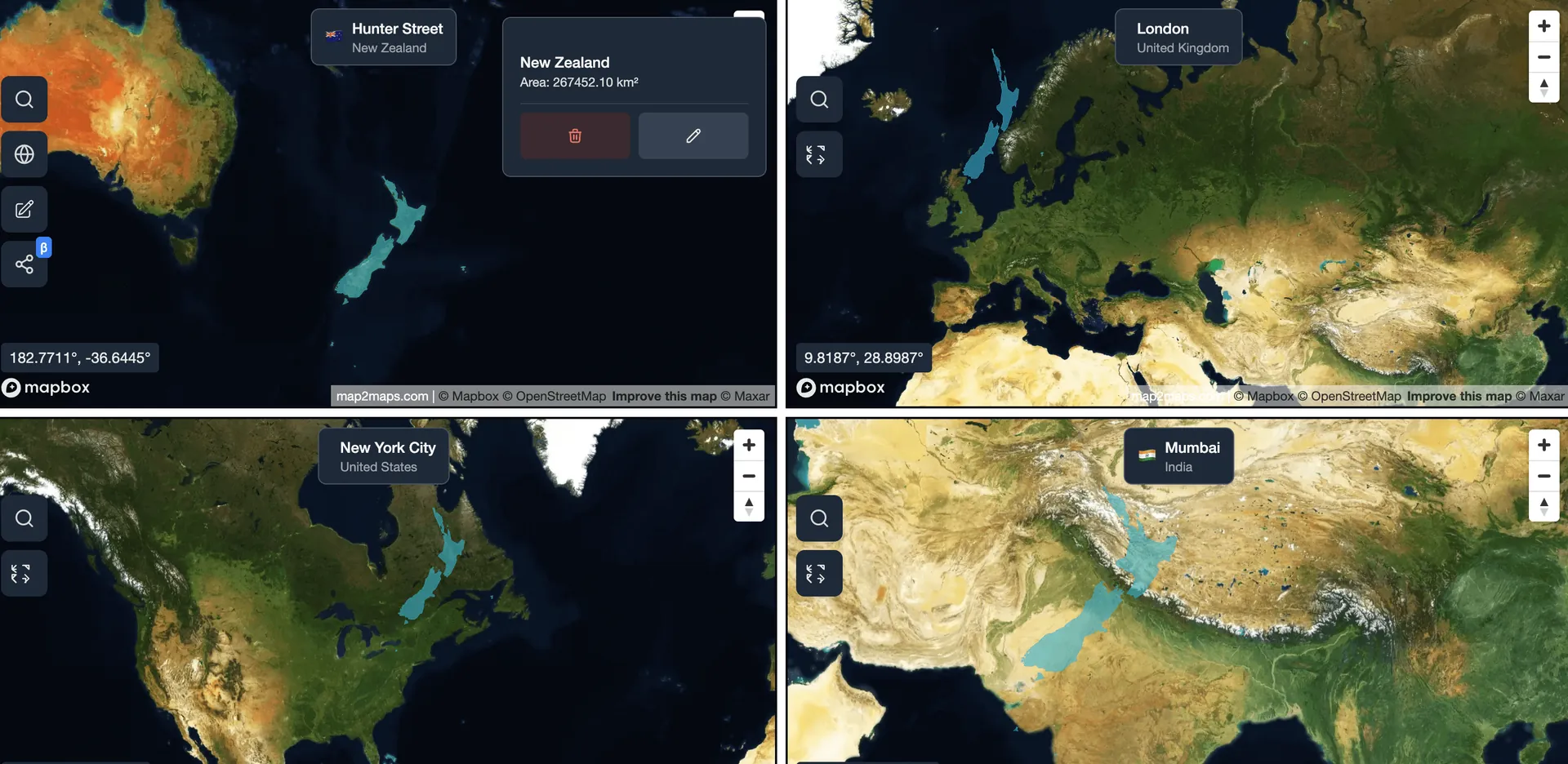
Explore for Yourself
Ready to dive deeper? Compare countries and see how Web Mercator changes their apparent size at different latitudes.
Sponsored
Products we use and recommend
Support Map2Maps by checking out these tools.
Sponsored
Send money internationally with Wise
Save up to 6x on international transfers with real exchange rates
Try WiseSponsored
Learn Languages with Langi.app
Read bite-sized stories with audio to learn languages at your level
Start LearningSponsored
Ship faster with bunny.net
Global CDN, storage, and media delivery tools that keep websites and video fast worldwide.
Explore bunny.netSponsored
Move faster with Raycast
A keyboard-first launcher with extensions, snippets, and AI to speed up everyday work.
Try RaycastSponsored
Build referral programs with Refgrow
A referral program platform for SaaS and AI products with automated tracking, commission management, and payouts.
Explore Refgrow