Philippines vs. Italy: Same Land, Double the People
The Philippines covers 300,000 km² to Italy's 301,340 km², under 0.5% apart. Yet the Philippines holds nearly double Italy's population.
Map2Maps Team
Few pairings on this site are as close by area as the Philippines and Italy. The gap is under half a percent — statistically a tie. Everything downstream of that number diverges sharply.
Key Takeaways: - The Philippines covers 300,000 km² against Italy's 301,340 km², a difference of just 0.4% - The Philippines holds nearly double Italy's population: 117.5 million versus 58.9 million - Italy's economy is still more than 5 times the Philippines'
How Close in Size Are the Philippines and Italy?
Nearly identical. The Philippines covers 300,000 km² (115,831 sq mi) and Italy covers 301,340 km² (116,348 sq mi) (CIA World Factbook, 2026) — a gap of just 1,340 km², under half a percent, making this one of the closest area matchups on this site.
Drag the Philippines onto Italy on the interactive map — at this scale, the two shapes almost exactly cover each other.
Same Footprint, Very Different Population
Despite occupying almost identical land area, the Philippines holds an estimated 117.5 million people (CIA World Factbook, 2025 est.) against Italy's roughly 58.9 million — nearly double, packed onto essentially the same amount of land. The Philippines' population density works out to around 392 people per km²; Italy's to about 196, exactly half.
Both countries are also demographically diverging: the Philippines' population continues to grow at a healthy rate, with a median age in the mid-20s, while Italy's population has begun shrinking, with one of the world's oldest median ages, in the mid-to-late 40s. If both trends continue, the population gap between these two near-identical-sized countries will only widen further.
Two Different Shapes of "Island Nation"
The Philippines is an archipelago of over 7,600 islands, with the vast majority of its population concentrated on the two largest, Luzon and Mindanao, and the Visayas group between them. That fragmentation shapes everything from infrastructure to disaster response, since a typhoon or earthquake affecting one island group often leaves others entirely untouched.
Italy is a single connected peninsula plus two major islands, Sicily and Sardinia — a fundamentally different kind of "spread out" than the Philippines' thousands of separate landmasses, even though the total area comes out almost the same.
Compare Any Country on Earth
Save unlimited comparisons and return to them whenever you need them, with priority support included.
Economy: The Gap Reasserts Itself
Italy's economy remains far larger despite the near-identical land area and smaller population: roughly $2.54 trillion nominal (IMF, 2025 estimate) against the Philippines' approximately $491 billion (IMF, 2025 estimate) — more than 5 times bigger. GDP per capita makes the contrast sharpest: Italy's works out to roughly $43,100 per person; the Philippines' to about $4,180, a gap of more than 10 to 1.
Terrain and Climate
The Philippines sits entirely in the tropics, with a monsoon-driven wet and dry season, frequent typhoons (the country sees more tropical cyclones than almost anywhere else on Earth), and volcanic mountainous terrain across most of its major islands, including Mount Apo (2,954 m), the country's highest point.
Italy's climate is Mediterranean along the coasts and more continental in the Po Valley and the Alps, which form the country's northern border and highest terrain (excluding Mont Blanc's shared summit). The Apennines run the length of the peninsula, and active volcanism persists at Vesuvius and Etna, a rare point of genuine geological similarity with the Philippines' own volcanic activity.
Interactive Exploration
Explore this comparison on our interactive map tool
Explore Interactive MapOverlay the two and the area match becomes obvious immediately — this is one of the closest size pairings featured on this site, even though the shapes themselves could hardly look more different.
Fun Facts
Philippines:
- An archipelago of over 7,600 islands, only about 2,000 of which are inhabited
- Experiences roughly 20 typhoons a year, more than almost any other country
- Home to the Banaue Rice Terraces, carved into mountainsides over 2,000 years ago
- English and Filipino are both official languages, alongside dozens of regional languages
Italy:
- Home to more UNESCO World Heritage Sites than any other country
- Vesuvius, near Naples, is one of the most closely monitored active volcanoes in the world
- Has the oldest continuously operating university in the Western world, Bologna, founded in 1088
- Produces more wine by volume than any other country most years
Conclusion
The Philippines and Italy are, almost coincidentally, nearly the same size by area — a genuine rarity at this scale. What happens on top of that identical footprint could hardly differ more: nearly double the population on the Philippine side, more than five times the economic output on Italy's, and two completely different geographic identities, one an archipelago of thousands of islands, the other a single connected peninsula.
Sources and method
- Country areas and Philippines population: CIA World Factbook
- Italy population: World Bank Open Data
- GDP estimates: International Monetary Fund
- Boundary geometry: Natural Earth
Method: boundaries come from Natural Earth 3.3.0 (1:50m). Areas are computed with Turf's geodesic area function over the polygon geometry, so they do not depend on the Web Mercator projection used for display. Figures include inland water and follow each source's treatment of disputed boundaries.
Note: GDP figures are 2025 IMF nominal estimates and can vary by a few percent between sources for the current year. Philippines population figures vary slightly by source (roughly 116.8-118.3 million for 2025); this article uses a midpoint estimate.
Figures checked 22 September 2026.
Frequently Asked Questions
Are the Philippines and Italy the same size?
Does the Philippines or Italy have more people?
Is Italy's economy bigger than the Philippines'?
How many islands does the Philippines have?
Why does the Philippines get so many typhoons?
Use our interactive map tool to compare the Philippines and Italy with any other country. For another near-identical area matchup, see Mexico vs. Indonesia, or Italy vs. New Zealand for a different Italy pairing.
Related Articles
UK vs. Japan: Two Island Nations, One 55% Bigger
Japan covers 377,975 km² to the UK's 243,610 km², about 55% larger, yet the UK has fewer people. Compare two archipelago nations.
Norway vs Japan: Norway Is Bigger, by Just 2%
Norway covers 385,207 km² and Japan 377,975 km², within 7,000 km² of each other. Drag Norway onto Japan on our interactive map to see two near-twins.
Bangladesh vs. Greece: Similar Land, 17x the People
Bangladesh covers 148,460 km² to Greece's 131,957 km², about 13% larger. Yet Bangladesh holds nearly 17 times Greece's population.
Explore for Yourself
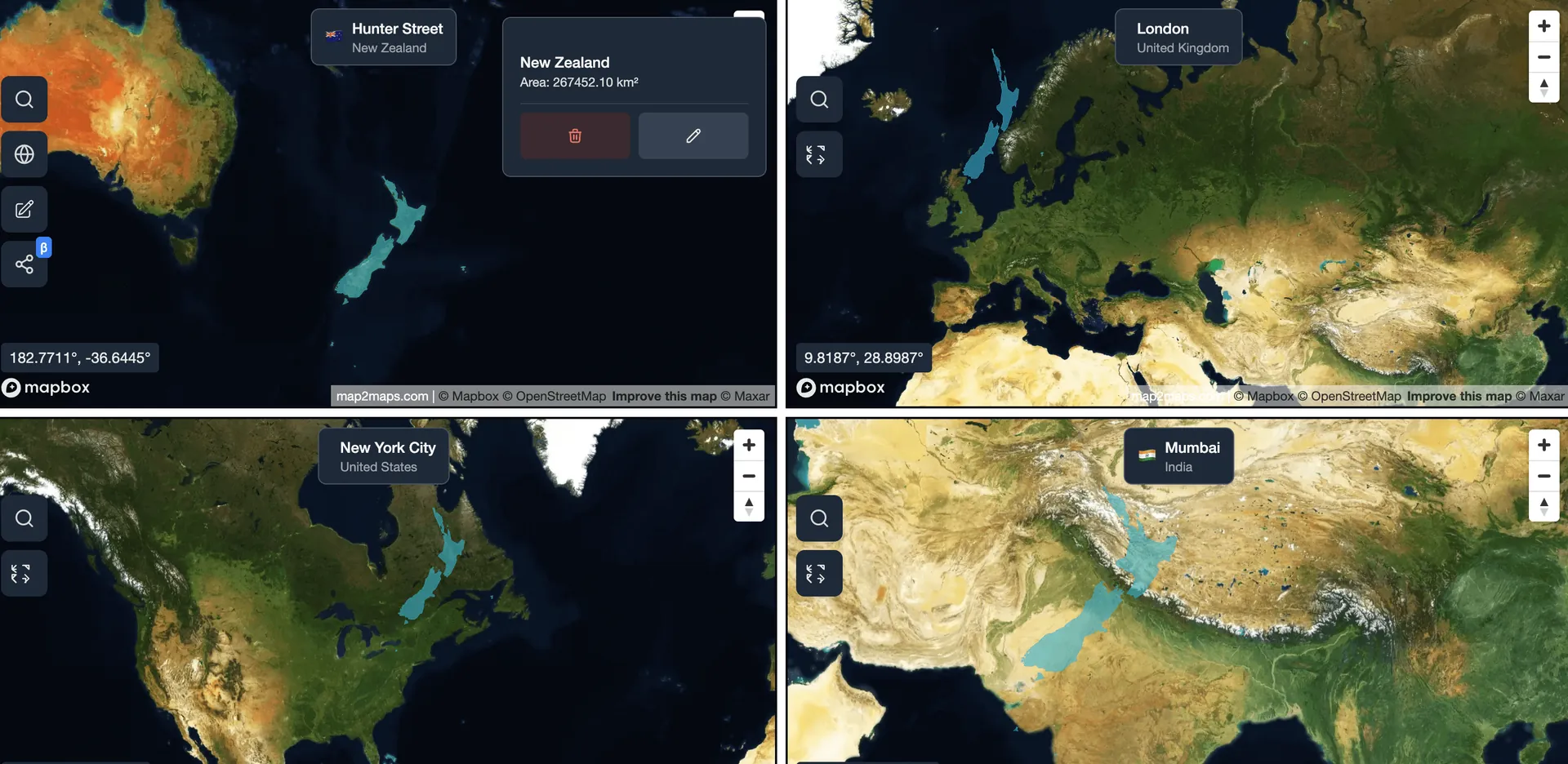
Ready to dive deeper? Compare countries and see how Web Mercator changes their apparent size at different latitudes.
Sponsored
Products we use and recommend
Support Map2Maps by checking out these tools.
Sponsored
Send money internationally with Wise
Save up to 6x on international transfers with real exchange rates
Try WiseSponsored
Learn Languages with Langi.app
Read bite-sized stories with audio to learn languages at your level
Start LearningSponsored
Ship faster with bunny.net
Global CDN, storage, and media delivery tools that keep websites and video fast worldwide.
Explore bunny.netSponsored
Move faster with Raycast
A keyboard-first launcher with extensions, snippets, and AI to speed up everyday work.
Try RaycastSponsored
Build referral programs with Refgrow
A referral program platform for SaaS and AI products with automated tracking, commission management, and payouts.
Explore Refgrow