Russia vs. Canada: Is Russia Really 2x Bigger?
Russia covers 17,098,242 km² against Canada's 9,984,670 km², about 71% larger — a rare case where Mercator isn't exaggerating much.
Map2Maps Team
Russia and Canada are the two largest countries on Earth, both stretched across the high Arctic latitudes where the standard world map inflates everything it touches. For once, that inflation is not the whole story.
Key Takeaways: - Russia covers 17,098,242 km² against Canada's 9,984,670 km², about 71% larger - Both countries reach past 80°N, so both are heavily inflated by Mercator — but the real gap between them is still enormous - Russia alone spans 11 time zones, more than any other country
How Much Bigger Is Russia Than Canada?
About 71% bigger. Russia covers 17,098,242 km² (6,601,670 sq mi) and Canada covers 9,984,670 km² (3,855,100 sq mi) (CIA World Factbook, 2026), a gap of roughly 7.1 million km² — on its own, larger than India.
Does the Map Exaggerate This One Too?
Less than usual. Both countries reach deep into the Arctic — Russia's northern islands pass 81°N, and Canada's Ellesmere Island reaches past 83°N — so both are heavily stretched by the Mercator projection most web maps use. Because the inflation applies to both sides of the comparison at similar latitudes, it does not create the false impression it does elsewhere on this site. The true ratio (1.71 to 1) and the on-screen Mercator ratio end up fairly close, which makes Russia vs. Canada an unusual case: one of the few "obviously huge" comparisons where the standard map is not badly misleading you.
Overlay Russia on Canada directly and see how far past Canada's western edge Russia's landmass still reaches.
Two Countries, One Kind of Emptiness
Russia and Canada are the two most sparsely populated large countries on Earth, and for a similar reason: brutal winters and permafrost across most of their northern territory make large stretches practically uninhabitable at scale. Russia holds about 143.7 million people (UN Population Division, 2025), a density of roughly 8.4 per km². Canada holds about 41.7 million (Statistics Canada, 2025), a density of about 4.2 per km², roughly half of Russia's despite the smaller landmass.
Both populations cluster hard along their southern borders. The overwhelming majority of Canadians live within 150 km of the US border, and the majority of Russians live in the European western fifth of the country, west of the Ural Mountains — meaning most of Russia's vast eastern expanse, Siberia and the Far East, is even emptier than the national average suggests.
Terrain: Taiga, Tundra, and Two Kinds of Vast
Russia's terrain runs from the Caucasus in the south to Arctic tundra in the north, but the defining feature is taiga: the world's largest forest biome, a belt of coniferous forest stretching unbroken from the Baltic to the Pacific. Siberia alone, at roughly 13.1 million km², would be the world's largest country if it were independent.
Canada's terrain runs similarly wide: the Canadian Shield's ancient bedrock covers half the country, the Rockies define the west, and the Arctic Archipelago's islands fragment the far north into a maze of channels and ice. Both countries hold roughly a fifth of the world's fresh water within their borders.
Compare Any Country on Earth
Save unlimited comparisons and return to them whenever you need them, with priority support included.
Interactive Exploration
Explore this comparison on our interactive map tool
Explore Interactive MapSlide Russia across Canada and it swallows the entire country with more than 7 million km² left over — roughly another India's worth of unused space.
Economy: A Closer Race Than the Land Suggests
Russia's economy runs about $2.5 trillion nominal (IMF, 2025 estimate), leaning heavily on oil, natural gas, and other resource exports. Canada's economy is roughly $2.2 trillion (IMF, 2025 estimate), more diversified across resources, manufacturing, and services.
Despite a 71% land advantage, Russia's economic edge over Canada is much narrower, and both countries derive an outsized share of national income from resource extraction relative to their population size — a pattern common to large, sparsely populated, resource-rich nations.
Fun Facts
Russia:
- Spans 11 time zones, more than any other country
- Lake Baikal, in Siberia, holds about 20% of the world's unfrozen fresh water
- Its Far East coast is closer to Alaska than to Moscow
- Home to Mount Elbrus (5,642 m), Europe's highest peak by some definitions
Canada:
- Has the world's longest coastline at roughly 202,080 km
- Contains more lakes than the rest of the world's countries combined
- The Canadian Arctic Archipelago holds over 36,000 islands
- Nunavut alone, one of Canada's three territories, is larger than Mexico
Conclusion
Russia is genuinely, substantially bigger than Canada — 71% larger, a gap that holds up even after accounting for the fact that both countries sit in the part of the map that Mercator inflates most. What sets this comparison apart from most others on this site is that the map, for once, is not the main source of the "wow" factor. The countries really are that vast.
Sources and method
- Country areas: CIA World Factbook
- Russia population: UN Population Division
- Canada population: Statistics Canada
- GDP estimates: International Monetary Fund
- Boundary geometry: Natural Earth
Method: boundaries come from Natural Earth 3.3.0 (1:50m). Areas are computed with Turf's geodesic area function over the polygon geometry, so they do not depend on the Web Mercator projection used for display. Figures include inland water and follow each source's treatment of disputed boundaries.
Note: GDP figures are 2025 IMF nominal estimates and can vary by a few percent between sources for the current year. Russia and Canada population figures are the most recent full-year estimates available.
Figures checked 22 September 2026.
Frequently Asked Questions
Is Russia bigger than Canada?
Are Russia and Canada both exaggerated by map projections?
Which has more people, Russia or Canada?
Is Russia's economy bigger than Canada's?
How many time zones does Russia span?
Use our interactive map tool to compare Russia and Canada with any other country. For more of the world's largest nations, see the full ranking of the largest countries by area, or how Canada compares to all of Europe.
Related Articles
Bangladesh vs. Greece: Similar Land, 17x the People
Bangladesh covers 148,460 km² to Greece's 131,957 km², about 13% larger. Yet Bangladesh holds nearly 17 times Greece's population.
Pakistan vs. France Size Comparison
Pakistan covers 796,095 km² to France's 551,695 km², about 44% larger, with nearly 4x the population. Yet France's economy is ~8x bigger.
Philippines vs. Italy: Same Land, Double the People
The Philippines covers 300,000 km² to Italy's 301,340 km², under 0.5% apart. Yet the Philippines holds nearly double Italy's population.
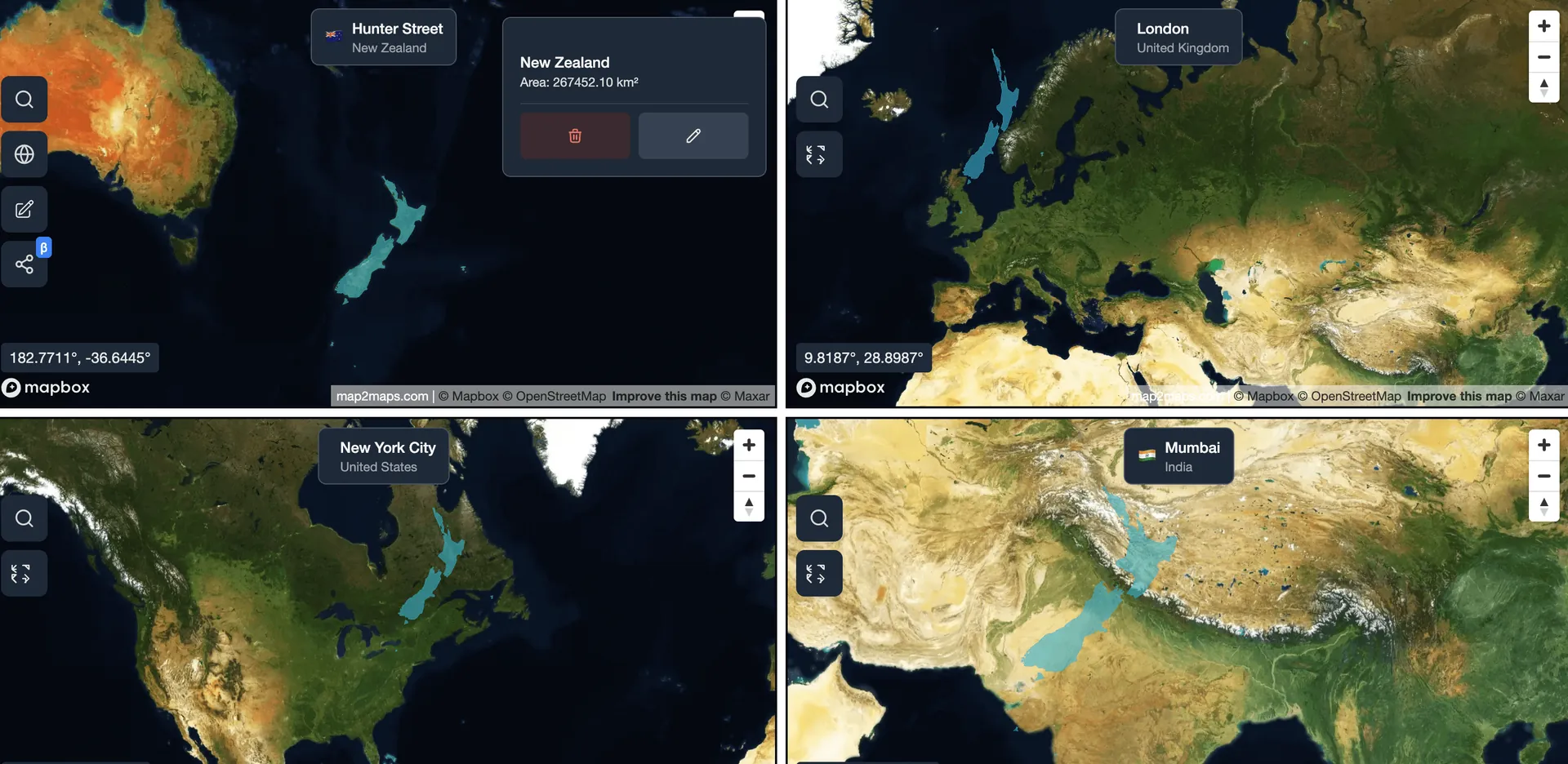
Explore for Yourself
Ready to dive deeper? Compare countries and see how Web Mercator changes their apparent size at different latitudes.
Sponsored
Products we use and recommend
Support Map2Maps by checking out these tools.
Sponsored
Send money internationally with Wise
Save up to 6x on international transfers with real exchange rates
Try WiseSponsored
Learn Languages with Langi.app
Read bite-sized stories with audio to learn languages at your level
Start LearningSponsored
Ship faster with bunny.net
Global CDN, storage, and media delivery tools that keep websites and video fast worldwide.
Explore bunny.netSponsored
Move faster with Raycast
A keyboard-first launcher with extensions, snippets, and AI to speed up everyday work.
Try RaycastSponsored
Build referral programs with Refgrow
A referral program platform for SaaS and AI products with automated tracking, commission management, and payouts.
Explore Refgrow