India vs. China Size Comparison: China Is 3x Bigger
China covers 9,596,961 km² to India's 3,287,263 km², almost 3x larger. Yet India overtook China in population in 2023.
Map2Maps Team
China and India together hold more than a third of humanity, yet one of them is nearly three times the size of the other. The country with less land now has more people.
Key Takeaways: - China covers 9,596,961 km² against India's 3,287,263 km², about 2.9 times larger - India overtook China as the world's most populous country in 2023, despite its much smaller area - India's population density is more than 3 times China's
How Much Bigger Is China Than India?
Nearly three times. China covers 9,596,961 km² (3,705,407 square miles) and India covers 3,287,263 km² (1,269,219 square miles) (CIA World Factbook, 2026), a gap of about 6.31 million km². That gap alone is nearly twice India's entire area.
China ranks 4th in the world by area; India ranks 7th, behind Russia, Canada, the United States, China, Brazil, and Australia — see the full ranking here.
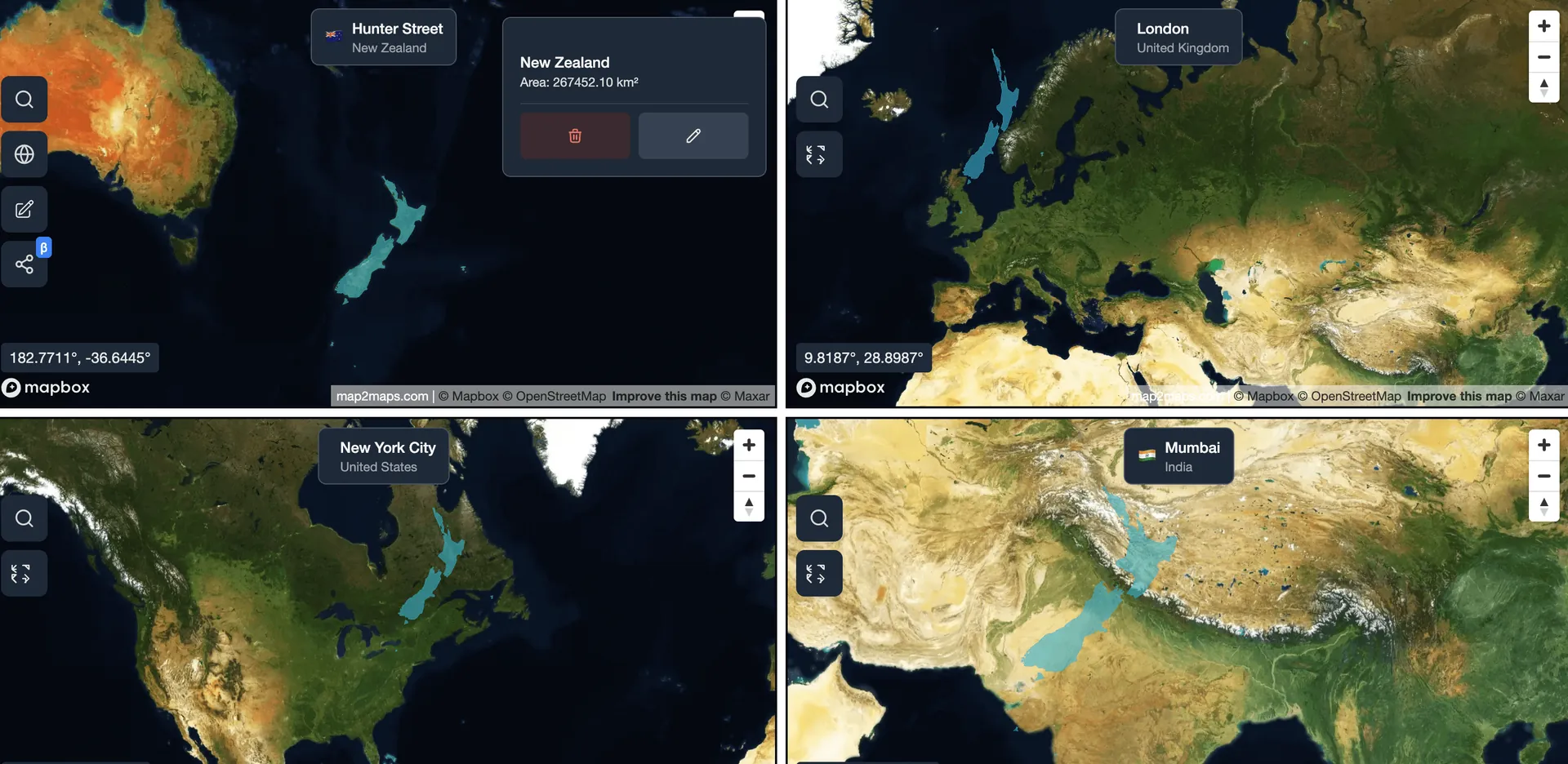
Drag India onto China on the interactive map and see how much of China's territory is left uncovered once India is placed inside it.
The Population Reversal Nobody Expected
For most of modern history, China had the larger population by a wide margin. That changed in 2023, when India overtook China to become the world's most populous country. As of 2025, India holds an estimated 1.46 billion people against China's roughly 1.41 billion (UN Population Division, 2025).
The consequence is stark: India now packs slightly more people than China into well under half the land. India's population density runs around 444 people per km²; China's is about 147 — meaning India is roughly 3 times denser than China despite ranking well behind it by total area.
China's population has begun shrinking, a legacy of the one-child policy (1980–2015) intersecting with a modernizing, urbanizing society. India's population is still growing, though its growth rate has also slowed considerably.
Why the Land Doesn't Distort as Much as Usual
Both countries sit largely in the mid-to-low latitudes — China spans roughly 18°N to 53°N and India roughly 8°N to 37°N — so Mercator distortion is milder here than in comparisons involving Canada, Russia, or Greenland. India in particular sits close enough to the equator that its true size and its Mercator-map size are nearly identical. China's northern reaches are stretched somewhat more, but the gap between the two countries on a standard map is reasonably close to the real 2.9-to-1 ratio.
Compare Any Country on Earth
Save unlimited comparisons and return to them whenever you need them, with priority support included.
Terrain: From the Himalayas to the Gobi
China's terrain spans the full range from Tibetan Plateau highlands, averaging over 4,000 m and home to Mount Everest's north face, through the Gobi and Taklamakan deserts in the north and west, down to fertile river plains and a densely populated eastern seaboard. That geographic split explains why China's population, despite the country's vast size, concentrates overwhelmingly in the eastern third.
India's terrain is more compact but no less varied: the Himalayas form its entire northern border, the Indo-Gangetic Plain across the north holds a huge share of the population, the Thar Desert covers the northwest, and the Deccan Plateau dominates the south between two coastal mountain ranges, the Western and Eastern Ghats.
Interactive Exploration
Explore this comparison on our interactive map tool
Explore Interactive MapOverlay the two and India covers roughly a third of China's footprint, mostly along its southern edge — a visual reminder of just how much of China's land lies further north and west than India reaches at all.
Economy: Still a Wide Gap
China's economy remains far larger: roughly $19.5 trillion nominal (IMF, 2025 estimate), the world's second-largest. India's economy is about $4.1 trillion (IMF, 2025 estimate), the world's fourth or fifth largest depending on the year and measurement. China's economy is currently around 4 to 5 times India's, a much wider gap than the population comparison would suggest, reflecting decades of earlier industrialization and a large manufacturing and export base.
Fun Facts
China:
- Home to Mount Everest's north face and K2's eastern approaches, among the world's highest terrain
- Has the world's longest continuous defensive wall, the Great Wall, spanning over 21,000 km including all branches
- Contains 34 provincial-level divisions across a single time zone, despite spanning five geographic time zones' worth of longitude
- The Yangtze is Asia's longest river at roughly 6,300 km
India:
- Home to Cherrapunji and Mawsynram, among the wettest inhabited places on Earth
- Has 22 officially recognized languages and hundreds more spoken regionally
- The Thar Desert is one of the most densely populated deserts in the world
- Mumbai's metropolitan population alone exceeds that of most entire countries
Conclusion
China is nearly three times India's size by area, yet India has edged ahead in population as of 2023 and now holds the title of the world's most populous country. The two nations, sitting side by side in Asia, tell a story less about which is "bigger" and more about how differently size and population can diverge: China's advantage in land has not translated into more people, and India's advantage in people has not (yet) translated into a comparable economy.
Sources and method
- Country areas: CIA World Factbook
- Population estimates: UN Population Division
- GDP estimates: International Monetary Fund
- Boundary geometry: Natural Earth
Method: boundaries come from Natural Earth 3.3.0 (1:50m). Areas are computed with Turf's geodesic area function over the polygon geometry, so they do not depend on the Web Mercator projection used for display. Figures include inland water and follow each source's treatment of disputed boundaries.
Note: China's GDP figure is a 2025 estimate and varies noticeably between sources (roughly $18-21 trillion depending on methodology and revision); treat it as an order-of-magnitude figure rather than a precise value. Population figures are UN 2025 estimates.
Figures checked 22 September 2026.
Frequently Asked Questions
Is China bigger than India?
Does India or China have more people?
Why does India have a higher population density than China?
Is China's economy bigger than India's?
What is the highest point in China and India?
Use our interactive map tool to compare India and China with any other country. See how they stack up in the full ranking of the world's largest countries, or how Brazil compares to India for another population-density contrast.
Related Articles
Bangladesh vs. Greece: Similar Land, 17x the People
Bangladesh covers 148,460 km² to Greece's 131,957 km², about 13% larger. Yet Bangladesh holds nearly 17 times Greece's population.
Pakistan vs. France Size Comparison
Pakistan covers 796,095 km² to France's 551,695 km², about 44% larger, with nearly 4x the population. Yet France's economy is ~8x bigger.
Philippines vs. Italy: Same Land, Double the People
The Philippines covers 300,000 km² to Italy's 301,340 km², under 0.5% apart. Yet the Philippines holds nearly double Italy's population.
Explore for Yourself
Ready to dive deeper? Compare countries and see how Web Mercator changes their apparent size at different latitudes.
Sponsored
Products we use and recommend
Support Map2Maps by checking out these tools.
Sponsored
Send money internationally with Wise
Save up to 6x on international transfers with real exchange rates
Try WiseSponsored
Learn Languages with Langi.app
Read bite-sized stories with audio to learn languages at your level
Start LearningSponsored
Ship faster with bunny.net
Global CDN, storage, and media delivery tools that keep websites and video fast worldwide.
Explore bunny.netSponsored
Move faster with Raycast
A keyboard-first launcher with extensions, snippets, and AI to speed up everyday work.
Try RaycastSponsored
Build referral programs with Refgrow
A referral program platform for SaaS and AI products with automated tracking, commission management, and payouts.
Explore Refgrow