UK vs. Japan: Two Island Nations, One 55% Bigger
Japan covers 377,975 km² to the UK's 243,610 km², about 55% larger, yet the UK has fewer people. Compare two archipelago nations.
Map2Maps Team
Japan and the United Kingdom are both archipelago nations, both sit off the coast of a much larger continental landmass, and both punch well above their size economically. Japan is also considerably bigger, a gap that surprises people who picture the two as roughly similar.
Key Takeaways: - Japan covers 377,975 km² against the UK's 243,610 km², about 55% larger - Japan has 123.1 million people to the UK's 69.6 million, despite a shrinking population - Both are archipelagos: Japan has over 14,000 islands, the UK more than 6,000
How Much Bigger Is Japan Than the UK?
About 55% bigger. Japan covers 377,975 km² (145,937 sq mi) and the United Kingdom covers 243,610 km² (94,058 sq mi) (CIA World Factbook, 2026), a gap of roughly 134,365 km², an area larger than England on its own.
Both countries are frequently pictured as similarly sized "offshore" nations next to their neighboring continents, but Japan's mountainous main islands cover considerably more ground than Great Britain and Ireland combined.
Drag the UK onto Japan on the interactive map and see how much of Honshu alone is left uncovered.
Two Archipelagos, Very Different Shapes
Japan consists of four main islands — Honshu, Hokkaido, Kyushu, and Shikoku — plus over 14,000 smaller islands strung roughly 3,000 km from north to south, from subarctic Hokkaido to subtropical Okinawa. That stretch alone is comparable to the distance from northern Scotland to the Sahara.
The United Kingdom sits on a tighter cluster: Great Britain, Northern Ireland (sharing an island with the Republic of Ireland), and more than 6,000 smaller islands, spanning roughly 1,000 km north-south from the Shetlands to the Channel Islands. Japan's elongated shape gives it a far wider range of climate zones for a similar-shaped nation.
Population: The Gap Runs the Other Way
Japan holds about 123.1 million people; the UK holds about 69.6 million (UN Population Division, 2025) — Japan has roughly 1.77 times the UK's population, a larger multiple than its 1.55x land advantage. Japan's population density runs about 326 people per km², among the highest of any large country; the UK's is about 286, itself one of the densest in Europe.
The trajectories are diverging sharply. Japan's population has been shrinking since around 2010, driven by one of the world's lowest birth rates and limited immigration. The UK's population is still growing, driven mostly by immigration, and is projected to continue rising through at least the 2030s. If current trends hold, the population gap between these two countries will narrow considerably in the coming decades.
Compare Any Country on Earth
Save unlimited comparisons and return to them whenever you need them, with priority support included.
Terrain and Climate
Japan is dominated by mountains: roughly 73% of the country is mountainous or hilly, leaving a narrow band of habitable coastal plain where the vast majority of its population and cities are packed. Mount Fuji (3,776 m) is the highest point, and the country sits on the Pacific Ring of Fire, making earthquakes and volcanic activity a routine part of life. Climate ranges from humid continental in Hokkaido to humid subtropical in the south.
The UK's terrain is gentler overall: the Scottish Highlands hold the highest ground (Ben Nevis, 1,345 m), rolling hills and lowlands dominate England and Wales, and the climate is temperate maritime throughout, with far less seasonal or regional extremity than Japan experiences end to end.
Interactive Exploration
Explore this comparison on our interactive map tool
Explore Interactive MapOverlay the two and the UK very nearly covers Japan's main island, Honshu, on its own — the UK is only slightly smaller — before you even add Hokkaido, Kyushu, Shikoku, and the rest of Japan's territory on top.
Economy: A Closer Contest Than the Land Suggests
Japan's economy runs about $4.28 trillion nominal (IMF, 2025 estimate), the world's fourth-largest. The UK's economy is about $3.96 trillion (IMF, 2025 estimate), the sixth-largest. Despite Japan's larger population and land area, the gap between the two economies is narrow, within about 8%, reflecting the UK's outsized financial and services sector relative to its size.
Fun Facts
Japan:
- Sits on the Pacific Ring of Fire, with roughly 110 active volcanoes
- Has the world's oldest continuously operating hotel, founded in 705 AD
- Tokyo's metropolitan area is the most populous urban area in the world
- Experiences several thousand earthquakes a year, though most are too small to feel
United Kingdom:
- Created the world's first public railway and underground metro system
- Common Law, developed in England, underpins the legal systems of dozens of countries
- Has more castles per square kilometre than almost any other country
- Greenwich, London, defines the Prime Meridian, 0° longitude
Conclusion
Japan is genuinely the larger of the two by a comfortable 55% margin, and has more people to match, even as its population shrinks and the UK's grows. What ties the two together isn't size at all: both are island nations that built outsized global influence, in trade, culture, and finance, from a comparatively small landmass off the edge of a much larger continent.
Sources and method
- Country areas: CIA World Factbook
- Population estimates: UN Population Division
- GDP estimates: International Monetary Fund
- Boundary geometry: Natural Earth
Method: boundaries come from Natural Earth 3.3.0 (1:50m). Areas are computed with Turf's geodesic area function over the polygon geometry, so they do not depend on the Web Mercator projection used for display. Figures include inland water and follow each source's treatment of disputed boundaries.
Note: UK area and population refer to the United Kingdom of Great Britain and Northern Ireland. GDP figures are 2025 IMF nominal estimates and can vary by a few percent between sources for the current year.
Figures checked 22 September 2026.
Frequently Asked Questions
Is Japan bigger than the UK?
Does Japan or the UK have more people?
Is the UK's economy bigger than Japan's?
How many islands do Japan and the UK have?
Would the UK fit inside Japan?
Use our interactive map tool to compare the UK and Japan with any other country or region. For more island-nation comparisons, see Iceland vs. Ireland or New Zealand.
Related Articles
Philippines vs. Italy: Same Land, Double the People
The Philippines covers 300,000 km² to Italy's 301,340 km², under 0.5% apart. Yet the Philippines holds nearly double Italy's population.
Norway vs Japan: Norway Is Bigger, by Just 2%
Norway covers 385,207 km² and Japan 377,975 km², within 7,000 km² of each other. Drag Norway onto Japan on our interactive map to see two near-twins.
Bangladesh vs. Greece: Similar Land, 17x the People
Bangladesh covers 148,460 km² to Greece's 131,957 km², about 13% larger. Yet Bangladesh holds nearly 17 times Greece's population.
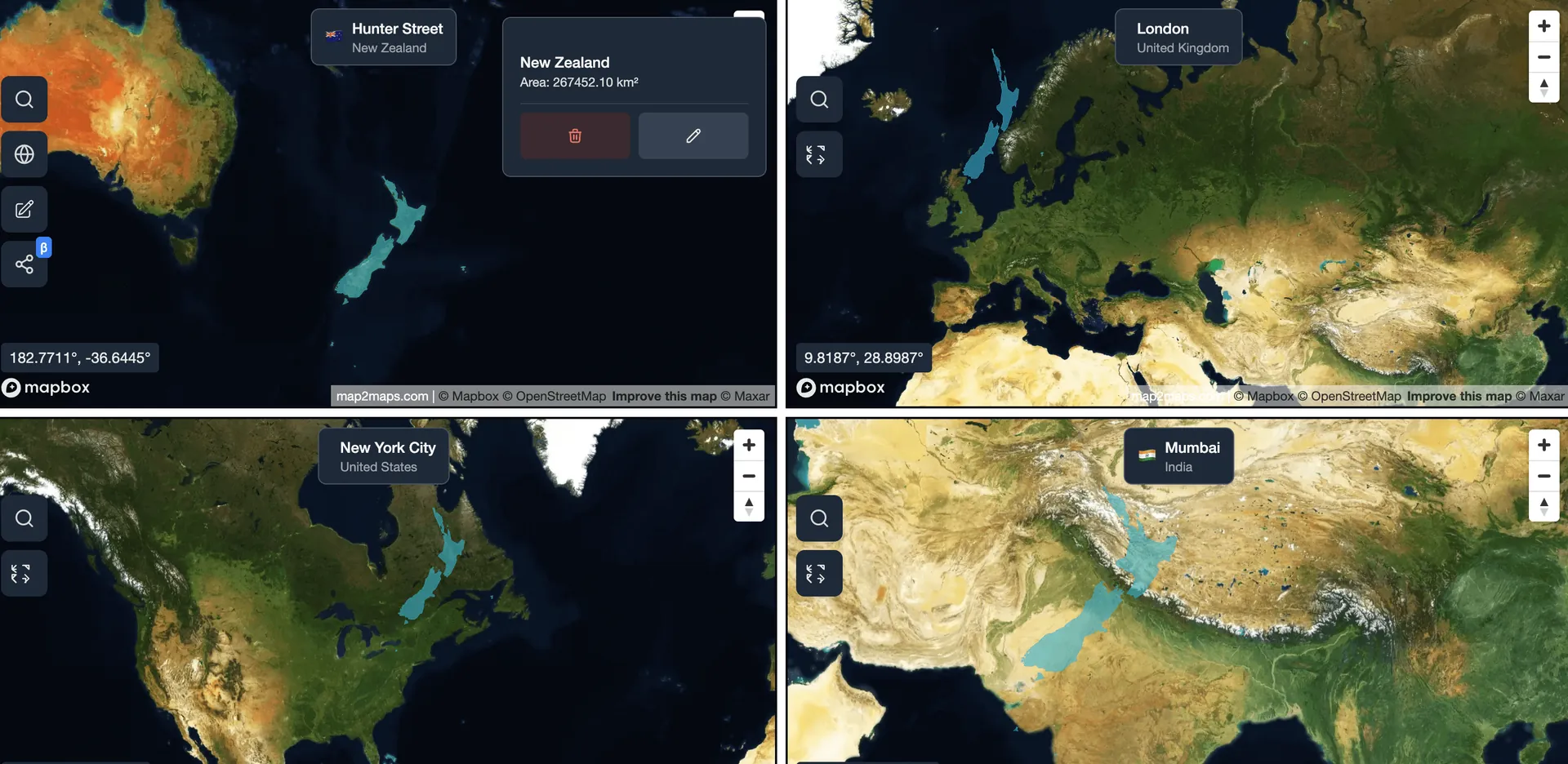
Explore for Yourself
Ready to dive deeper? Compare countries and see how Web Mercator changes their apparent size at different latitudes.
Sponsored
Products we use and recommend
Support Map2Maps by checking out these tools.
Sponsored
Send money internationally with Wise
Save up to 6x on international transfers with real exchange rates
Try WiseSponsored
Learn Languages with Langi.app
Read bite-sized stories with audio to learn languages at your level
Start LearningSponsored
Ship faster with bunny.net
Global CDN, storage, and media delivery tools that keep websites and video fast worldwide.
Explore bunny.netSponsored
Move faster with Raycast
A keyboard-first launcher with extensions, snippets, and AI to speed up everyday work.
Try RaycastSponsored
Build referral programs with Refgrow
A referral program platform for SaaS and AI products with automated tracking, commission management, and payouts.
Explore Refgrow