South Korea vs. Germany Size Comparison
Germany covers 357,022 km² to South Korea's 99,720 km², about 3.6x larger. Yet South Korea built one of the world's dozen biggest economies.
Map2Maps Team
Germany and South Korea are routinely compared as manufacturing and export powerhouses, "Asia's Germany" is a phrase that gets used often enough to be a cliché. The size gap behind that comparison is much larger than the economic one.
Key Takeaways: - Germany covers 357,022 km² against South Korea's 99,720 km², about 3.6 times larger - South Korea's economy, at roughly $1.87 trillion, is over a third of Germany's $5.01 trillion from a fraction of the land - South Korea's population density is more than 6 times Germany's
How Much Bigger Is Germany Than South Korea?
About 3.6 times bigger. Germany covers 357,022 km² (137,847 sq mi) and South Korea covers 99,720 km² (38,502 sq mi) (CIA World Factbook, 2026), a gap of roughly 257,300 km², an area larger than the entire United Kingdom.
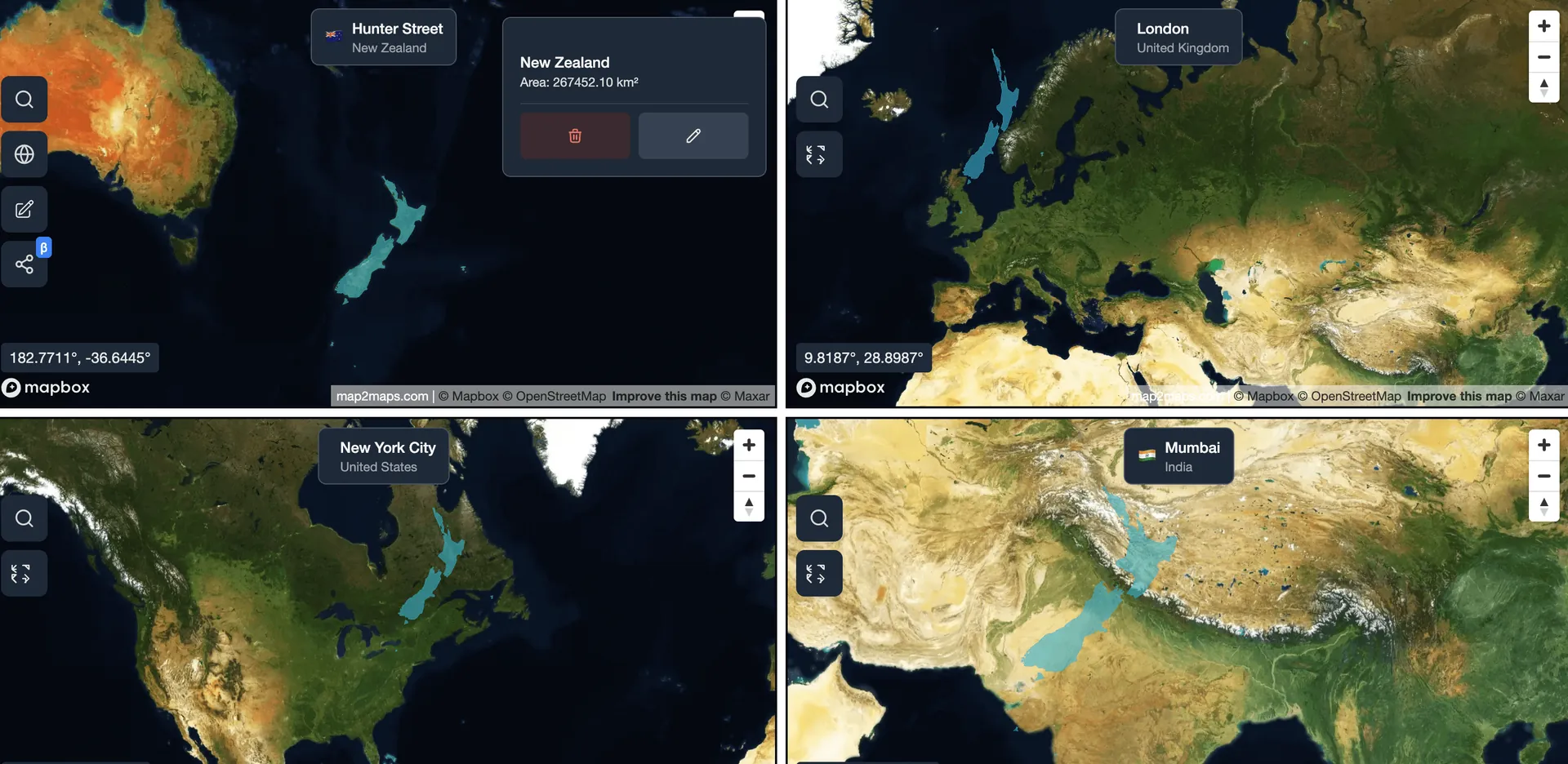
Drag South Korea onto Germany on the interactive map and see how much of Germany's territory is left once South Korea's outline is placed inside it.
Similar Reputation, Very Different Scale
Both countries are known globally for precision manufacturing, major export brands, and dense industrial economies — Germany for automobiles and machinery, South Korea for electronics, shipbuilding, and semiconductors. That shared reputation obscures how differently sized the two actually are: Germany's economy runs about $5.01 trillion nominal (IMF, 2025 estimate), the world's third-largest, while South Korea's is about $1.87 trillion (IMF, 2025 estimate), the world's 12th-13th largest depending on the year.
Germany's economy is roughly 2.7 times South Korea's, a far narrower gap than the 3.6-times difference in land area. South Korea's GDP per capita, at around $36,300, is not far behind Germany's roughly $59,000 — both rank among the world's high-income economies, and South Korea has closed a meaningful share of the historical gap between the two over the past three decades.
Population Density: No Comparison at All
South Korea's population density is one of the highest of any large country: roughly 517 people per km², driven heavily by the Seoul Capital Area, which holds about half of South Korea's entire population of 51.5 million in a metropolitan region covering a small fraction of the country's total land. Germany's density is around 238 per km², itself high by European standards but distributed far more evenly across dozens of major cities rather than concentrated in one dominant metropolitan area.
South Korea's density works out to more than double Seoul's own numbers again once you account for how much of the country is mountainous and unsuited to dense settlement — roughly 70% of South Korea is mountains or hills, which concentrates its 51.5 million people even more tightly onto the coastal plains and river valleys that remain.
Compare Any Country on Earth
Save unlimited comparisons and return to them whenever you need them, with priority support included.
Terrain and Climate
South Korea is dominated by mountains and hills across roughly 70% of its territory, with the Taebaek range running along the east coast and Hallasan (1,947 m), a volcanic peak on Jeju Island, as the highest point. The climate is humid continental in the north, transitioning to humid subtropical in the south, with a distinct monsoon season in summer.
Germany's terrain is more varied across a much larger area: the North German Plain in the north, central uplands through the middle of the country, and the Bavarian Alps along the southern border with Austria, where the Zugspitze (2,962 m) is the highest point. The climate is temperate throughout, without South Korea's sharper seasonal monsoon pattern.
Interactive Exploration
Explore this comparison on our interactive map tool
Explore Interactive MapOverlay the two and South Korea covers roughly a quarter of Germany's footprint — a useful corrective for a comparison that reputation makes feel closer than the geography actually is.
Fun Facts
South Korea:
- Home to some of the world's fastest average internet speeds
- Seoul's subway system is among the longest and busiest in the world
- Produces a large share of the world's memory chips and semiconductors
- Jeju Island, a volcanic island south of the mainland, is a UNESCO World Heritage Site
Germany:
- Home to the autobahn, sections of which have no general speed limit
- Has the largest economy in Europe and the third-largest in the world
- The Rhine and Danube, two of Europe's most important rivers, both flow through Germany
- Oktoberfest in Munich is the world's largest folk festival, drawing millions of visitors annually
Conclusion
Germany is genuinely the much bigger country, nearly four times South Korea's size, but the economic comparison that made "Asia's Germany" a cliché in the first place holds up far better than the land area does. South Korea has built one of the world's most productive economies onto a footprint smaller than most of Germany's individual regions.
Sources and method
- Country areas: CIA World Factbook
- Population estimates: UN Population Division / World Bank Open Data
- GDP estimates: International Monetary Fund
- Boundary geometry: Natural Earth
Method: boundaries come from Natural Earth 3.3.0 (1:50m). Areas are computed with Turf's geodesic area function over the polygon geometry, so they do not depend on the Web Mercator projection used for display. Figures include inland water and follow each source's treatment of disputed boundaries.
Note: GDP figures are 2025 IMF nominal estimates and can vary by a few percent between sources for the current year.
Figures checked 22 September 2026.
Frequently Asked Questions
Is Germany bigger than South Korea?
Is Germany's economy bigger than South Korea's?
Why is South Korea's population density so high?
Why is South Korea sometimes called 'Asia's Germany'?
What is the highest point in South Korea?
Use our interactive map tool to compare South Korea and Germany with any other country. For another Asia-Europe pairing, see Japan vs. Germany, or UK vs. Japan for an island-nation matchup.
Related Articles
Bangladesh vs. Greece: Similar Land, 17x the People
Bangladesh covers 148,460 km² to Greece's 131,957 km², about 13% larger. Yet Bangladesh holds nearly 17 times Greece's population.
Pakistan vs. France Size Comparison
Pakistan covers 796,095 km² to France's 551,695 km², about 44% larger, with nearly 4x the population. Yet France's economy is ~8x bigger.
Philippines vs. Italy: Same Land, Double the People
The Philippines covers 300,000 km² to Italy's 301,340 km², under 0.5% apart. Yet the Philippines holds nearly double Italy's population.
Explore for Yourself
Ready to dive deeper? Compare countries and see how Web Mercator changes their apparent size at different latitudes.
Sponsored
Products we use and recommend
Support Map2Maps by checking out these tools.
Sponsored
Send money internationally with Wise
Save up to 6x on international transfers with real exchange rates
Try WiseSponsored
Learn Languages with Langi.app
Read bite-sized stories with audio to learn languages at your level
Start LearningSponsored
Ship faster with bunny.net
Global CDN, storage, and media delivery tools that keep websites and video fast worldwide.
Explore bunny.netSponsored
Move faster with Raycast
A keyboard-first launcher with extensions, snippets, and AI to speed up everyday work.
Try RaycastSponsored
Build referral programs with Refgrow
A referral program platform for SaaS and AI products with automated tracking, commission management, and payouts.
Explore Refgrow