South Africa vs. Egypt Size Comparison
South Africa covers 1,219,090 km² to Egypt's 1,010,408 km², about 21% larger. Africa's two largest economies, settled very differently.
Map2Maps Team
South Africa and Egypt are, by most recent estimates, Africa's two largest economies. They are also settled about as differently as two countries can be: one almost entirely along a single river, the other spread across its full territory.
Key Takeaways: - South Africa covers 1,219,090 km² against Egypt's 1,010,408 km², about 21% larger - Egypt's population is more than 6 times denser, with over 95% crammed into the Nile Valley and Delta - Together they are, by most estimates, Africa's two largest national economies
How Much Bigger Is South Africa Than Egypt?
About 21% bigger. South Africa covers 1,219,090 km² (470,691 sq mi) and Egypt covers 1,010,408 km² (390,121 sq mi) (CIA World Factbook, 2026), a gap of roughly 208,682 km², close to the area of the United Kingdom.
Neither country is Africa's largest by area — that title belongs to Algeria, at 2,381,741 km², more than either of these countries combined. South Africa and Egypt earn their comparison from a different metric: economic weight.
Drag Egypt onto South Africa on the interactive map to see how much bigger one of Africa's two largest economies actually is than the other.
Two Very Different Settlement Patterns
Egypt's population concentrates almost entirely along the Nile. Roughly 95% of Egyptians live within the Nile Valley and Delta, a ribbon of fertile land covering something on the order of 40,000 km², or about 4% of the country's total area. The rest is desert, largely uninhabited outside a handful of oasis towns and coastal cities.
South Africa's roughly 63 million people (World Bank Open Data, 2025 estimate) are spread far more evenly, concentrated in a handful of major metropolitan areas — Johannesburg, Cape Town, Durban, Pretoria — but without anything resembling Egypt's single dominant corridor. The result is that Egypt's population density, calculated against total area, comes out to around 111 people per km², while its effective density within the inhabited Nile ribbon runs into the thousands. South Africa's density is a comparatively even 52 per km² nationwide.
Terrain and Climate
Egypt is almost entirely desert: the Sahara covers the west, the Eastern Desert runs to the Red Sea, and the Sinai Peninsula bridges into Asia. The Nile, flowing north from Sudan to the Mediterranean, is the exception that makes the country habitable at all, and without it, Egypt's population story would look completely different.
South Africa's terrain is more varied: a central plateau, the Highveld, sits at 1,200 to 1,800 m and holds much of the country's agriculture and mining activity, ringed by the Great Escarpment and the Drakensberg mountains along the east. The coastline runs from Mediterranean-adjacent winter rainfall in the southwest around the Cape to subtropical conditions along the Indian Ocean in the east.
Compare Any Country on Earth
Save unlimited comparisons and return to them whenever you need them, with priority support included.
Interactive Exploration
Explore this comparison on our interactive map tool
Explore Interactive MapOverlay the two and South Africa's more evenly distributed bulk contrasts sharply with the narrow strip that actually holds Egypt's population.
Economy: Africa's Top Two
By most recent estimates, South Africa's economy runs around $427 billion nominal and Egypt's around $365-430 billion (IMF, 2025 estimate), with the exact ranking between the two shifting from year to year depending on currency movements and the measurement source. Together they are consistently counted among Africa's two largest economies, alongside Nigeria.
South Africa's economy leans on mining (platinum, gold, coal), finance, and manufacturing. Egypt's leans on the Suez Canal's transit revenue, tourism, natural gas, and remittances from Egyptians working abroad, with agriculture still concentrated almost entirely in the Nile corridor.
Fun Facts
South Africa:
- Has three capital cities: Pretoria (administrative), Cape Town (legislative), and Bloemfontein (judicial)
- Home to Table Mountain, one of the oldest mountains on Earth at over 260 million years
- Hosts the world's largest population of wild rhinos
- Has 12 official languages, more than any other country
Egypt:
- The Great Pyramid of Giza was the tallest human-made structure for almost 3,800 years
- The Suez Canal, opened in 1869, handles a significant share of global shipping traffic
- Nearly all of Egypt's fresh water comes from a single river, the Nile
- Cairo's metropolitan area is the largest in Africa and the Middle East
Conclusion
South Africa is the larger of the two by about a fifth, but the more striking contrast is how differently their populations are arranged: Egypt's people squeezed onto a sliver of habitable land along the Nile, South Africa's spread across a plateau with no single dominant corridor. Both, in their own way, have built the continent's largest economies out of very different geography.
Sources and method
- Country areas: CIA World Factbook
- South Africa population: World Bank Open Data
- GDP estimates: International Monetary Fund
- Boundary geometry: Natural Earth
Method: boundaries come from Natural Earth 3.3.0 (1:50m). Areas are computed with Turf's geodesic area function over the polygon geometry, so they do not depend on the Web Mercator projection used for display. Figures include inland water and follow each source's treatment of disputed boundaries.
Note: Egypt's area follows the government's published figure including the Sinai Peninsula; some international datasets quote 1,001,450 km². GDP figures for South Africa and Egypt are 2025 estimates and vary noticeably by source; the ranking between them shifts year to year.
Figures checked 22 September 2026.
Frequently Asked Questions
Is South Africa bigger than Egypt?
What are Africa's two largest economies?
Why does almost everyone in Egypt live in one small part of the country?
What is Africa's largest country by area?
How many official languages does South Africa have?
Use our interactive map tool to compare South Africa and Egypt with any other country. For Africa's largest country by area, see Argentina vs. Algeria, or Egypt vs. Turkey for another Nile-and-desert comparison.
Related Articles
DR Congo vs. France Size Comparison
DR Congo covers 2,344,858 km² to metropolitan France's 551,695 km², more than 4x larger — yet rarely pictured as one of the world's biggest.
Kenya vs. Madagascar: Same Land, 9x the Economy
Kenya covers 580,367 km² to Madagascar's 587,041 km², just 1% apart. Yet Kenya's economy runs roughly 9 times Madagascar's.
Morocco vs. Sweden Size Comparison
Morocco covers 446,550 km² to Sweden's 450,295 km², under 1% apart. Morocco has 3.5x the population, yet Sweden's economy is 4x bigger.
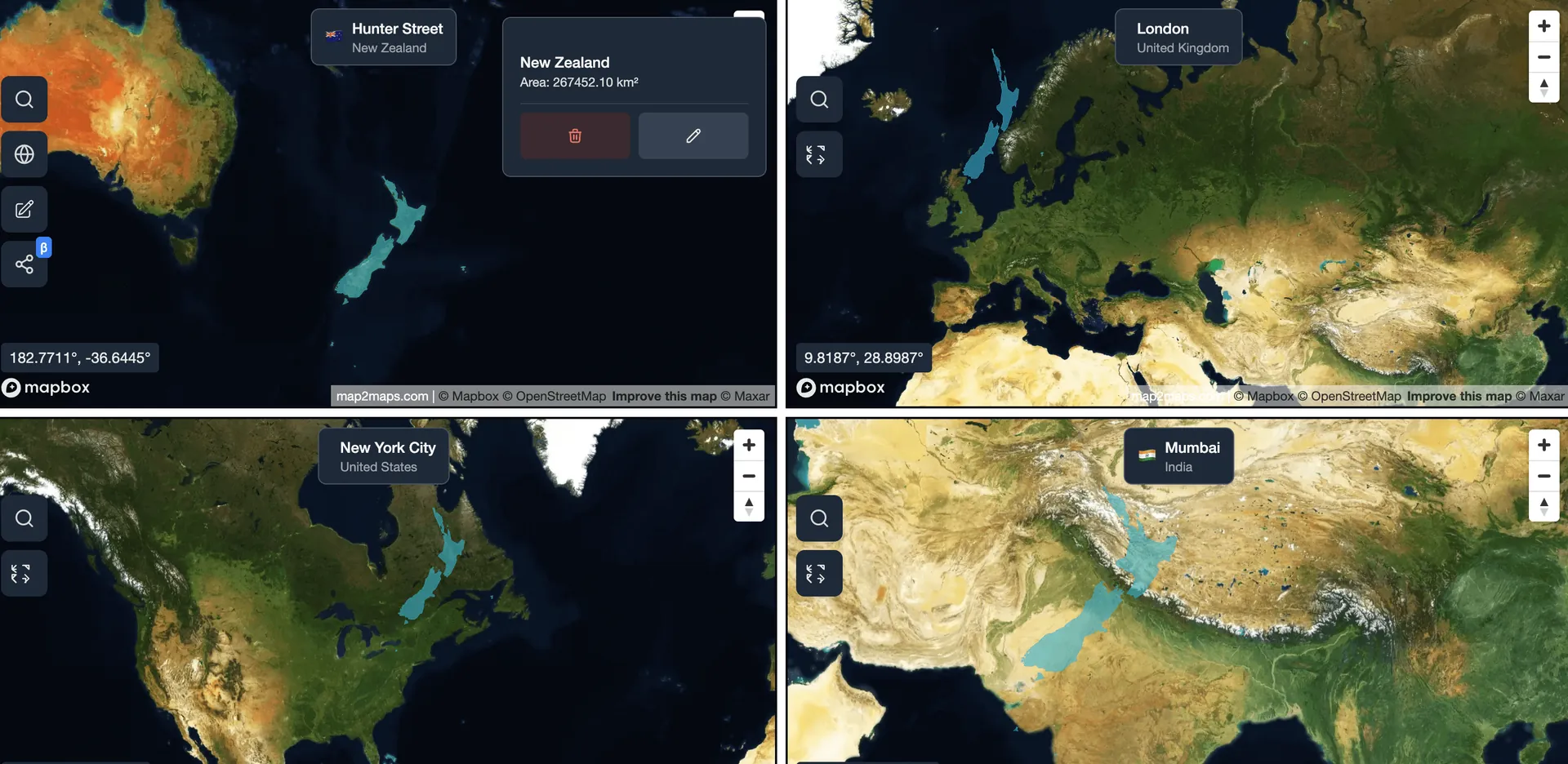
Explore for Yourself
Ready to dive deeper? Compare countries and see how Web Mercator changes their apparent size at different latitudes.
Sponsored
Products we use and recommend
Support Map2Maps by checking out these tools.
Sponsored
Send money internationally with Wise
Save up to 6x on international transfers with real exchange rates
Try WiseSponsored
Learn Languages with Langi.app
Read bite-sized stories with audio to learn languages at your level
Start LearningSponsored
Ship faster with bunny.net
Global CDN, storage, and media delivery tools that keep websites and video fast worldwide.
Explore bunny.netSponsored
Move faster with Raycast
A keyboard-first launcher with extensions, snippets, and AI to speed up everyday work.
Try RaycastSponsored
Build referral programs with Refgrow
A referral program platform for SaaS and AI products with automated tracking, commission management, and payouts.
Explore Refgrow