Argentina vs. Algeria: Which Country is Bigger?
Argentina is 17% larger than Algeria, but Mercator maps inflate the gap to nearly 2:1. Two vast countries, near-identical populations, opposite settlement.
Map2Maps Team
Argentina and Algeria are the second-largest country in South America and the largest in Africa respectively. Argentina is the larger of the two, though map projections exaggerate the gap.
Key Takeaways: - Argentina covers 2,780,400 km² against Algeria's 2,381,741 km², about 17% larger - Their populations are nearly identical at roughly 46 and 45 million - Mercator distortion inflates the visual gap to something closer to 2:1
How Much Bigger is Argentina Than Algeria?
Argentina is about 17% larger than Algeria. Argentina covers 2,780,400 km² and Algeria covers 2,381,741 km² (CIA World Factbook, 2026), a difference of 398,659 km² that works out to roughly the area of Japan.
That makes this one of the closer matchups among the world's ten largest countries.
Where Do They Rank Globally?
Argentina is the 8th largest country in the world and Algeria the 10th. Algeria took the African title in 2011, when Sudan split into Sudan and South Sudan.
Because the two sit so close together in the rankings, the visual comparison is genuinely informative rather than a foregone conclusion. Neither dwarfs the other.
Why Do Maps Exaggerate the Difference?
Argentina stretches all the way to 55°S, and Mercator inflates land progressively toward the poles. Scale factor is the multiplier a projection applies at a given latitude, and on Mercator at 55° it reaches about 1.74. Tierra del Fuego is therefore drawn at nearly twice its true width.
Algeria sits between roughly 19°N and 37°N, where distortion stays mild.
The projection consequently exaggerates an advantage Argentina genuinely has. On a Mercator world map Argentina can look close to twice Algeria's size. When we measured both boundaries geodesically instead, the honest ratio came out at 1.17 to 1.
Select Argentina and Algeria on the map to see their true sizes side by side.
How Are the Two Countries Shaped?
The two could hardly be shaped more differently.
A long, tapering wedge, Argentina runs roughly 3,700 km north-south but only about 1,400 km east-west at its widest. Squeezed between the Andes and the Atlantic, it narrows steadily toward Cape Horn, and almost every part of the country lies within reach of either the mountains or the sea.
Algeria, by contrast, is broad and blocky: about 2,000 km east-west and 2,100 km north-south. Its northern edge meets the Mediterranean along roughly 1,600 km of coast, and everything south of the Atlas Mountains opens into the Sahara.
Where Do People Actually Live?
Two countries of similar size and near-identical population, settled in completely different patterns.
Around 46 million people live in Argentina at roughly 17 per km² (World Bank Open Data, 2026). Roughly a third of them live in Greater Buenos Aires, and the fertile Pampas support most of the agriculture and settlement. Patagonia covers about a quarter of the country yet holds under 5% of the population.
Algeria holds around 45 million at roughly 19 per km², and its concentration is the more extreme of the two. Over 90% of Algerians live in the northern coastal strip, which accounts for something like 12% of national territory. Nine in ten people therefore occupy about an eighth of the land, which means the effective density of inhabited Algeria runs many times higher than the national average suggests. The Saharan provinces to the south rank among the emptiest inhabited regions anywhere on Earth, with some administrative areas larger than European countries supporting populations in the tens of thousands. Argentina's emptiness is milder and differently shaped, thinning gradually southward across Patagonia rather than dropping off a cliff at a mountain range.
Compare Any Country on Earth
Save unlimited comparisons and return to them whenever you need them, with priority support included.
Terrain and Climate
The country runs the full climatic range. The subtropical north takes in the Iguazú rainforest and the Gran Chaco, while the central Pampas are temperate grassland and some of the most productive farmland in the world. The Andes dominate the west, including Aconcagua at 6,961 m, the highest peak outside Asia. Farther south, cold and wind-scoured Patagonian steppe gives way to glaciers and fjords.
Algeria, meanwhile, is defined by one overwhelming fact: roughly 80% of it is Sahara.
The Tell Atlas and Saharan Atlas run parallel to the Mediterranean coast, trapping the moisture that makes a narrow fertile band possible. South of them the desert stretches 1,500 km to the borders of Mali and Niger, broken only by the volcanic Hoggar Mountains, where Mount Tahat rises to 2,908 m.
Interactive Exploration
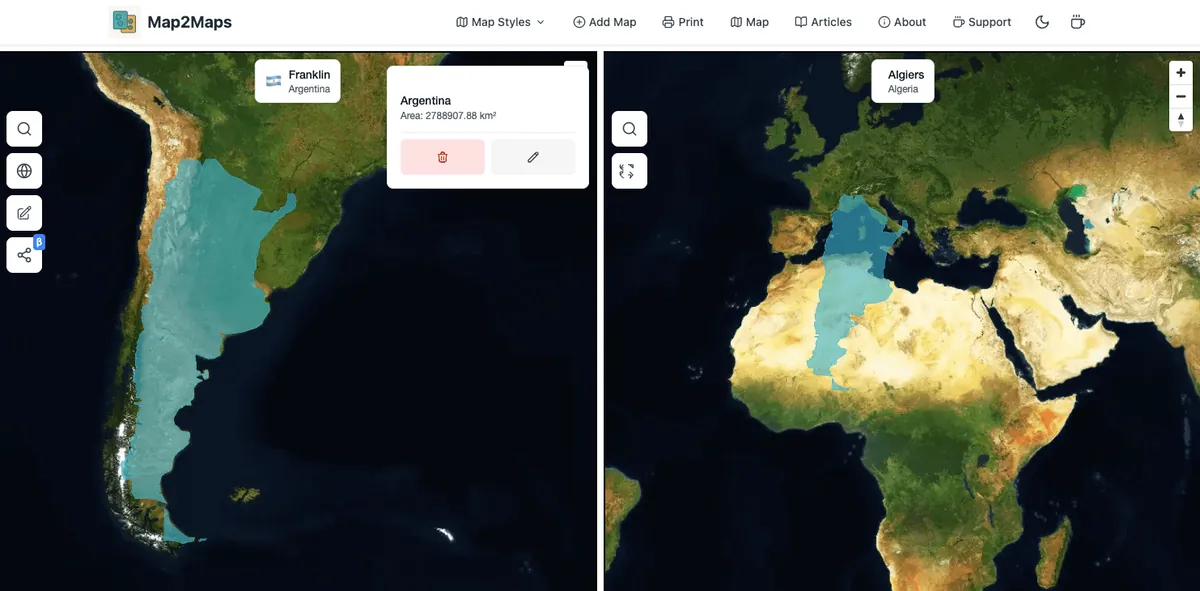
Explore this comparison on our interactive map tool
Explore Interactive MapOverlay the two and Argentina's north-south reach becomes obvious. It spans a range of latitudes Algeria never approaches.
Which Economy is Larger?
Argentina's economy is roughly 2.5 times the size of Algeria's and considerably more diversified.
Argentina:
- GDP: ~$640 billion
- GDP per capita: ~$13,700
- Major industries: Agriculture, automotive, lithium, wine
- Notable: Among the world's top beef and soybean exporters
Algeria:
- GDP: ~$250 billion
- GDP per capita: ~$5,500
- Major industries: Oil and natural gas, which dominate export earnings
- Notable: A major natural gas supplier to Europe
Algeria's output is heavily concentrated in hydrocarbons, which leaves it more exposed to energy price swings than Argentina's broader mix.
Natural Resources
Part of the lithium triangle sits in Argentina, shared with Chile and Bolivia. The country also holds Vaca Muerta, one of the largest unconventional oil and gas formations outside North America. Its most valuable resource, however, remains Pampas soil.
Algeria sits on major natural gas reserves and significant oil deposits, concentrated in the Saharan interior. Pipelines carry both north to the coast and onward under the Mediterranean to Europe. For Algeria, water rather than energy is the scarce resource.
Fun Facts
Argentina:
- Holds both the highest and lowest points in the Southern Hemisphere: Aconcagua at 6,961 m and Laguna del Carbón at −105 m
- Ushuaia is often described as the world's southernmost city
- The Perito Moreno glacier is one of the few worldwide that is not retreating
Algeria:
- Became Africa's largest country in 2011
- Its Sahara records some of the highest surface temperatures measured anywhere
- Tassili n'Ajjer holds rock art depicting a green, river-fed Sahara from around 10,000 years ago
Conclusion
Argentina and Algeria are both vast countries with diverse landscapes, and Argentina covers more land by a clear margin. The 17% gap becomes obvious on an accurate projection, rather than on a Mercator map that stretches Argentina's southern reach beyond recognition.
What makes the pair genuinely interesting is how similarly they are populated and how differently they are settled. Nearly the same number of people, nearly the same order of magnitude in area, and two completely different answers to where a country's population ends up.
Sources and method
- Country areas: CIA World Factbook
- Population and GDP: World Bank Open Data
- Boundary geometry: Natural Earth
Method: boundaries come from Natural Earth 3.3.0 (1:50m). Areas are computed with Turf's geodesic area function over the polygon geometry, so they do not depend on the Web Mercator projection used for display. Figures include inland water and follow each source's treatment of disputed boundaries.
Note: Algeria's area reflects its post-2011 borders, following the separation of South Sudan from Sudan that made Algeria the largest country in Africa.
Figures checked 17 August 2026.
Frequently Asked Questions
Is Argentina bigger than Algeria?
What is the largest country in Africa?
Why does Argentina look so much bigger than Algeria on world maps?
Do Argentina and Algeria have similar populations?
How much of Algeria is desert?
Use our interactive map tool to compare Argentina and Algeria with any country or region in the world.
For more size comparisons, see how Brazil compares to India or how European giants like France and Ukraine measure up. You can also see how island nations compare in our Madagascar and New Zealand size guides.
Related Articles
Colombia vs. Spain: Similar Populations, 4x Wealth Gap
Colombia covers 1,138,910 km² to Spain's 505,370 km², more than double. Populations are nearly identical, yet Spain's economy is 4x bigger.
DR Congo vs. France Size Comparison
DR Congo covers 2,344,858 km² to metropolitan France's 551,695 km², more than 4x larger — yet rarely pictured as one of the world's biggest.
Kenya vs. Madagascar: Same Land, 9x the Economy
Kenya covers 580,367 km² to Madagascar's 587,041 km², just 1% apart. Yet Kenya's economy runs roughly 9 times Madagascar's.
Explore for Yourself
Ready to dive deeper? Compare countries and see how Web Mercator changes their apparent size at different latitudes.
Sponsored
Products we use and recommend
Support Map2Maps by checking out these tools.
Sponsored
Send money internationally with Wise
Save up to 6x on international transfers with real exchange rates
Try WiseSponsored
Learn Languages with Langi.app
Read bite-sized stories with audio to learn languages at your level
Start LearningSponsored
Ship faster with bunny.net
Global CDN, storage, and media delivery tools that keep websites and video fast worldwide.
Explore bunny.netSponsored
Move faster with Raycast
A keyboard-first launcher with extensions, snippets, and AI to speed up everyday work.
Try RaycastSponsored
Build referral programs with Refgrow
A referral program platform for SaaS and AI products with automated tracking, commission management, and payouts.
Explore Refgrow