Kenya vs. Madagascar: Same Land, 9x the Economy
Kenya covers 580,367 km² to Madagascar's 587,041 km², just 1% apart. Yet Kenya's economy runs roughly 9 times Madagascar's.
Map2Maps Team
Kenya and Madagascar sit within a few hundred kilometres of each other across the Mozambique Channel, cover almost identical land area, and have followed very different economic paths from there.
Key Takeaways: - Kenya covers 580,367 km² against Madagascar's 587,041 km², a difference of just 1.1% - Kenya's population, at roughly 55.8 million, is about double Madagascar's 28 million - Kenya's economy runs roughly 9 times Madagascar's
How Do Kenya and Madagascar Compare in Size?
Almost exactly the same. Kenya covers 580,367 km² (224,081 sq mi) and Madagascar covers 587,041 km² (226,658 sq mi) (CIA World Factbook, 2026) — a gap of just 6,674 km², about 1.1%, making this one of the closest area matchups anywhere on this site.
Drag Madagascar onto Kenya on the interactive map and see just how closely the two shapes match in total area, despite looking nothing alike.
Mainland and Island, Diverging From an Even Start
Kenya's economy runs about $180 billion nominal (IMF, 2025 estimate); Madagascar's is roughly $19.4 billion (IMF, 2025 estimate) — Kenya's economy is about 9 times Madagascar's, despite the two countries occupying almost identical land area. Kenya holds roughly double Madagascar's population too: an estimated 55.8 million against 28 million, so population alone accounts for only part of the economic gap.
Kenya has built East Africa's most diversified economy, anchored by Nairobi as a regional financial and technology hub — sometimes called "Silicon Savannah" — alongside tourism, agriculture, and horticultural exports. Madagascar's economy remains more narrowly based on agriculture (vanilla, cloves, coffee) and mining, with its island geography adding shipping costs and logistical friction that mainland Kenya doesn't face to the same degree.
Same Area, Completely Different Shape
Kenya is a roughly compact block straddling the equator, split between highland plateau in the west, the Great Rift Valley running north-south through its centre, and arid lowlands covering much of the north and east. Madagascar is a single elongated island, stretching about 1,580 km north-south but only 570 km at its widest — a shape that packs the same total area into something far longer and narrower than Kenya's more rounded outline.
That shape difference matters for climate too: Madagascar's length gives it a sharp east-west split, wet rainforest on the windward east coast and dry spiny forest in the rain-shadowed southwest. Kenya's climate splits by elevation and distance from the coast instead, from humid tropical along the Indian Ocean to semi-arid and arid across the northern two-thirds of the country.
Compare Any Country on Earth
Save unlimited comparisons and return to them whenever you need them, with priority support included.
Terrain and Wildlife
Kenya's terrain centres on the Great Rift Valley, flanked by highlands that include Mount Kenya (5,199 m), Africa's second-highest peak. The savanna ecosystems of the Maasai Mara and Amboseli support some of the world's most famous wildlife populations and safari tourism industry. The northern two-thirds of the country is arid to semi-arid, sparsely populated, and home to pastoralist communities adapted to the dry conditions.
Madagascar separated from mainland Africa roughly 160 million years ago, and its isolation since then produced one of the most distinctive wildlife assemblages on Earth: around 90% of its species, including all its lemurs, are found nowhere else. Our dedicated Madagascar guide covers this in more depth.
Interactive Exploration
Explore this comparison on our interactive map tool
Explore Interactive MapOverlay the two and the near-perfect area match becomes visible immediately, even as Madagascar's elongated shape spills further in one direction than Kenya's more compact block does.
Fun Facts
Kenya:
- Home to the Great Rift Valley, part of a fracture system stretching thousands of kilometres across East Africa
- Nairobi is one of Africa's leading technology and financial hubs
- The Maasai Mara hosts the Great Migration, one of the largest wildlife movements on Earth
- Mount Kenya (5,199 m) is Africa's second-highest peak after Kilimanjaro
Madagascar:
- The world's fourth-largest island, separated from Africa for roughly 160 million years
- Home to all of the world's roughly 100 lemur species
- Supplies a large share of the world's natural vanilla
- Around 90% of its wildlife is found nowhere else on Earth
Conclusion
Kenya and Madagascar occupy almost exactly the same amount of land, a genuine coincidence between a mainland savanna nation and an isolated island ecosystem across the Mozambique Channel. From that even starting point, Kenya has built an economy roughly nine times Madagascar's — a gap this comparison makes far more visible than the land area alone ever would.
Sources and method
- Country areas: CIA World Factbook
- Population estimates: CIA World Factbook / World Bank Open Data
- GDP estimates: International Monetary Fund
- Boundary geometry: Natural Earth
Method: boundaries come from Natural Earth 3.3.0 (1:50m). Areas are computed with Turf's geodesic area function over the polygon geometry, so they do not depend on the Web Mercator projection used for display. Figures include inland water and follow each source's treatment of disputed boundaries.
Note: GDP figures are 2025 IMF nominal estimates and can vary by a few percent between sources for the current year.
Figures checked 22 September 2026.
Frequently Asked Questions
Is Kenya bigger than Madagascar?
Is Kenya's economy bigger than Madagascar's?
Does Kenya or Madagascar have more people?
Why is Nairobi called 'Silicon Savannah'?
How is Madagascar's wildlife different from Kenya's?
Use our interactive map tool to compare Kenya and Madagascar with any other country. For more on Madagascar's size and wildlife, see our dedicated Madagascar guide, or South Africa vs. Egypt for another African economic comparison.
Related Articles
DR Congo vs. France Size Comparison
DR Congo covers 2,344,858 km² to metropolitan France's 551,695 km², more than 4x larger — yet rarely pictured as one of the world's biggest.
Morocco vs. Sweden Size Comparison
Morocco covers 446,550 km² to Sweden's 450,295 km², under 1% apart. Morocco has 3.5x the population, yet Sweden's economy is 4x bigger.
Nigeria vs. UK: Bigger Land, Fraction of the Economy
Nigeria covers 923,768 km² to the UK's 243,610 km², nearly 4x larger, with more people too. Yet the UK's economy is still ~14x Nigeria's.
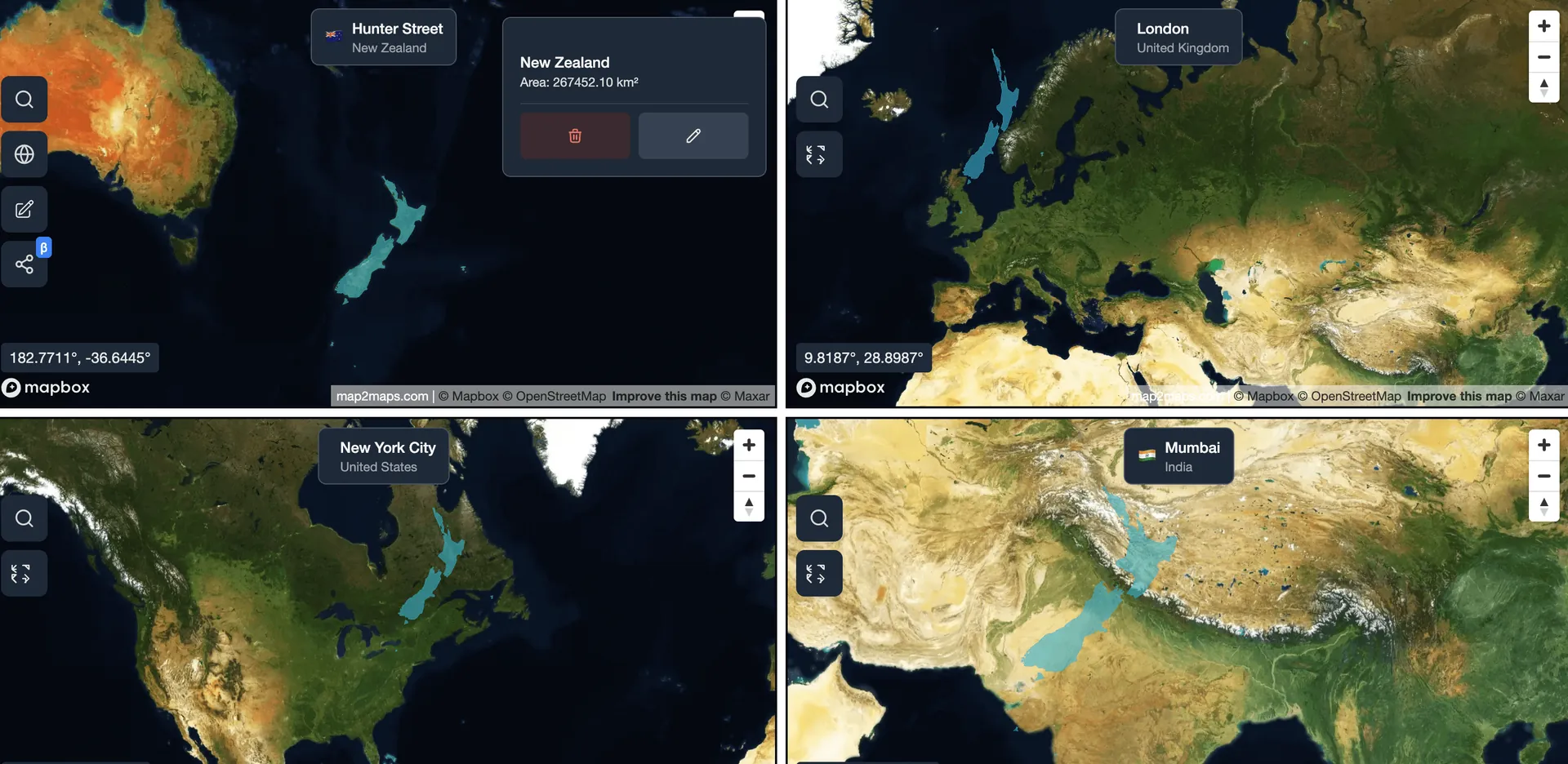
Explore for Yourself
Ready to dive deeper? Compare countries and see how Web Mercator changes their apparent size at different latitudes.
Sponsored
Products we use and recommend
Support Map2Maps by checking out these tools.
Sponsored
Send money internationally with Wise
Save up to 6x on international transfers with real exchange rates
Try WiseSponsored
Learn Languages with Langi.app
Read bite-sized stories with audio to learn languages at your level
Start LearningSponsored
Ship faster with bunny.net
Global CDN, storage, and media delivery tools that keep websites and video fast worldwide.
Explore bunny.netSponsored
Move faster with Raycast
A keyboard-first launcher with extensions, snippets, and AI to speed up everyday work.
Try RaycastSponsored
Build referral programs with Refgrow
A referral program platform for SaaS and AI products with automated tracking, commission management, and payouts.
Explore Refgrow