Colombia vs. Spain: Similar Populations, 4x Wealth Gap
Colombia covers 1,138,910 km² to Spain's 505,370 km², more than double. Populations are nearly identical, yet Spain's economy is 4x bigger.
Map2Maps Team
Colombia and Spain share a language, a colonial history running the other direction three centuries deep, and — almost exactly — a population. What they don't share is economic scale.
Key Takeaways: - Colombia covers 1,138,910 km² against Spain's 505,370 km², more than 2.25 times larger - Their populations are nearly identical: roughly 49.8 million versus 47.6 million - Despite that, Spain's economy is over 4 times Colombia's
How Much Bigger Is Colombia Than Spain?
More than 2.25 times. Colombia covers 1,138,910 km² (439,736 sq mi) and Spain covers 505,370 km² (195,124 sq mi) (CIA World Factbook, 2026), a gap of roughly 633,540 km², larger than France.
Drag Spain onto Colombia on the interactive map and see how much territory is left uncovered once Spain's outline is placed inside it.
A Population Match, an Economic Mismatch
Colombia holds an estimated 49.8 million people as of 2025 (CIA World Factbook, 2025 est.); Spain holds roughly 47.6 million — a gap of under 5%, closer than almost any other population comparison on this site.
The economies tell a completely different story. Spain's nominal GDP runs about $1.89 trillion (IMF, 2025 estimate); Colombia's is roughly $457 billion (IMF, 2025 estimate) — Spain's economy is more than 4 times Colombia's, despite the two countries holding almost identical populations on very different amounts of land. GDP per capita makes the gap starkest: Spain's works out to about $39,700 per person, Colombia's to around $9,200.
A Colonial History Running the Other Direction
Spanish colonization of what is now Colombia began in the early 16th century and lasted roughly 300 years, ending with independence in 1819 under Simón Bolívar. Spanish remains Colombia's official language, and the two countries share deep cultural, religious, and legal ties dating to that period — a very different colonial relationship from the UK-Nigeria or Spain's own more contested modern immigration debates involving Latin American arrivals.
Population Density and Settlement
Colombia's population density works out to roughly 44 people per km², concentrated heavily in the Andean highlands where Bogotá, Medellín, and Cali sit at elevation, with the Amazon and Pacific lowlands remaining comparatively empty. Spain's density is much higher at around 94 per km², concentrated around Madrid, Barcelona, and the Mediterranean and Atlantic coasts, with a notably empty interior — the phenomenon known in Spain as "la España vacía," empty Spain.
Compare Any Country on Earth
Save unlimited comparisons and return to them whenever you need them, with priority support included.
Terrain and Climate
Colombia is genuinely varied by geography rarely matched elsewhere: three parallel Andes ranges run through the west, the Amazon rainforest covers the south, Caribbean coast and desert sit in the north, and the Pacific coast is among the wettest places on Earth. Nearly every climate zone on the planet exists somewhere within Colombia's borders, a consequence of its equatorial location and dramatic elevation changes.
Spain's terrain is more contained: the Meseta Central plateau dominates the interior, the Pyrenees form the border with France, and climate ranges from Mediterranean along the coasts to a drier, more continental interior. The Sierra Nevada in the south holds mainland Spain's highest peak, Mulhacén, at 3,479 m.
Interactive Exploration
Explore this comparison on our interactive map tool
Explore Interactive MapOverlay the two and Spain covers well under half of Colombia's territory, with the Amazon basin alone extending far past Spain's outline in every direction.
Fun Facts
Colombia:
- Home to more bird species than any other country, over 1,900 recorded
- The only South American country with coastlines on both the Pacific and Caribbean
- Produces roughly 12% of the world's coffee, prized for its quality
- Has 311 protected areas covering about 15% of national territory
Spain:
- The world's second-most visited country by international tourist arrivals
- Home to more UNESCO World Heritage Sites than almost any other country
- Produces about 45% of the world's olive oil
- The Camino de Santiago pilgrimage route has drawn walkers for over a thousand years
Conclusion
Colombia is the larger country by a wide margin, more than doubling Spain's area, and the two nations hold almost identical populations. What separates them is economic output: Spain's economy remains more than four times Colombia's, a gap rooted in centuries of divergent development rather than anything visible on the map itself.
Sources and method
- Country areas and Colombia population: CIA World Factbook
- Spain population: World Bank Open Data
- GDP estimates: International Monetary Fund
- Boundary geometry: Natural Earth
Method: boundaries come from Natural Earth 3.3.0 (1:50m). Areas are computed with Turf's geodesic area function over the polygon geometry, so they do not depend on the Web Mercator projection used for display. Figures include inland water and follow each source's treatment of disputed boundaries.
Note: GDP figures are 2025 IMF nominal estimates and can vary by a few percent between sources for the current year.
Figures checked 22 September 2026.
Frequently Asked Questions
Is Colombia bigger than Spain?
Do Colombia and Spain have similar populations?
Is Spain's economy bigger than Colombia's?
How long did Spain colonize Colombia?
Why is Colombia so biodiverse?
Use our interactive map tool to compare Colombia and Spain with any other country. For another Latin American comparison, see Brazil vs. India, or Spain vs. Thailand for another Spain matchup.
Related Articles
Bangladesh vs. Greece: Similar Land, 17x the People
Bangladesh covers 148,460 km² to Greece's 131,957 km², about 13% larger. Yet Bangladesh holds nearly 17 times Greece's population.
DR Congo vs. France Size Comparison
DR Congo covers 2,344,858 km² to metropolitan France's 551,695 km², more than 4x larger — yet rarely pictured as one of the world's biggest.
Morocco vs. Sweden Size Comparison
Morocco covers 446,550 km² to Sweden's 450,295 km², under 1% apart. Morocco has 3.5x the population, yet Sweden's economy is 4x bigger.
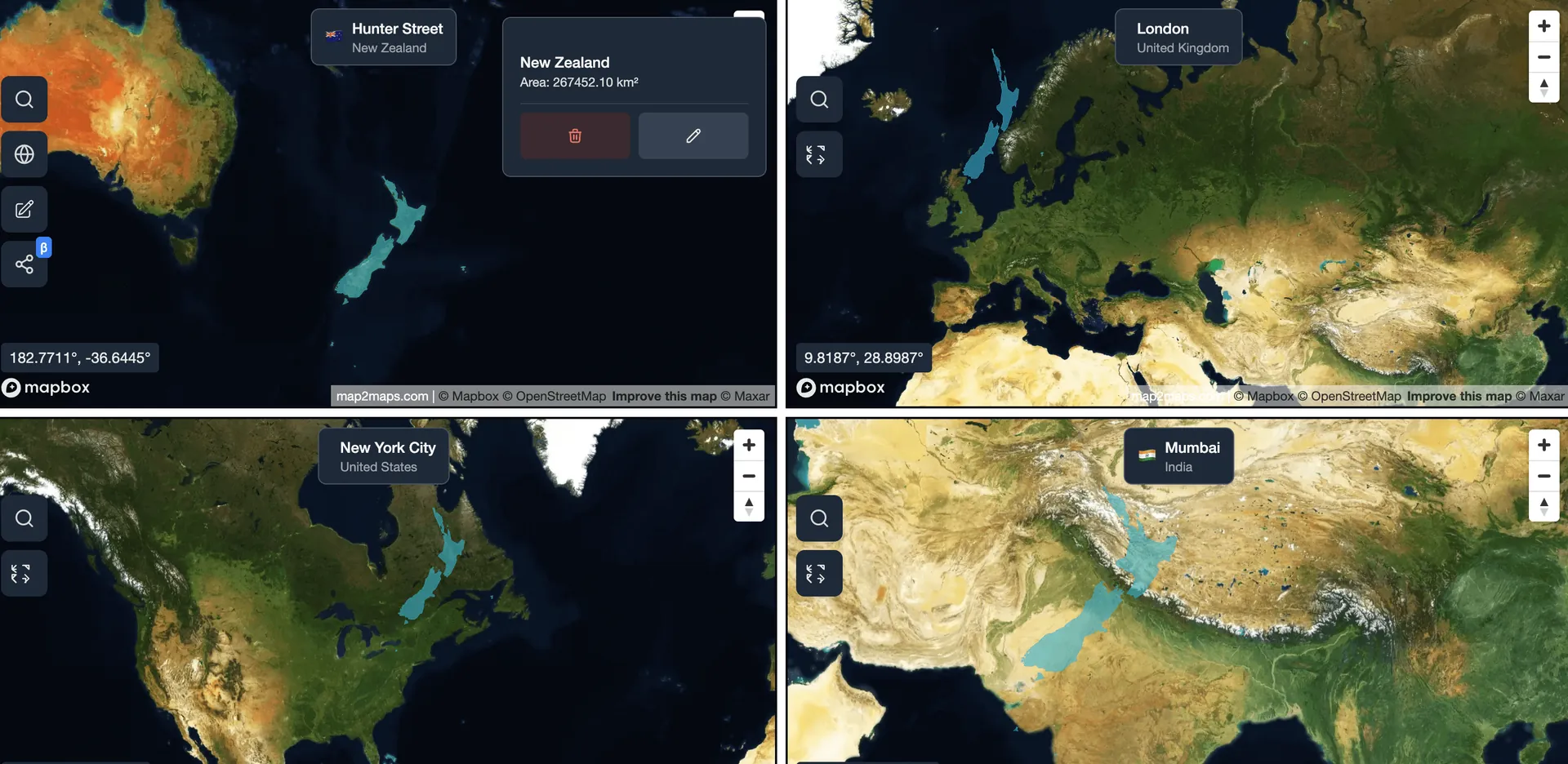
Explore for Yourself
Ready to dive deeper? Compare countries and see how Web Mercator changes their apparent size at different latitudes.
Sponsored
Products we use and recommend
Support Map2Maps by checking out these tools.
Sponsored
Send money internationally with Wise
Save up to 6x on international transfers with real exchange rates
Try WiseSponsored
Learn Languages with Langi.app
Read bite-sized stories with audio to learn languages at your level
Start LearningSponsored
Ship faster with bunny.net
Global CDN, storage, and media delivery tools that keep websites and video fast worldwide.
Explore bunny.netSponsored
Move faster with Raycast
A keyboard-first launcher with extensions, snippets, and AI to speed up everyday work.
Try RaycastSponsored
Build referral programs with Refgrow
A referral program platform for SaaS and AI products with automated tracking, commission management, and payouts.
Explore Refgrow