Tokyo Metropolitan Area vs New York City: A Scale Comparison
Tokyo and New York are the two largest metro areas in the developed world. Here's how their built-up area, metro region, and transport networks actually compare.
Map2Maps Team
Tokyo and New York are constantly compared as the world's two defining megacities, but their footprints are shaped very differently.
The Numbers
- Greater Tokyo urban area: ~8,547 km²
- Greater Tokyo metro area (incl. surrounding prefectures): ~13,452 km²
- New York urban landmass: ~12,093 km²
- New York metropolitan statistical area (MSA): ~15,903 km²
Quick Comparison: - New York's built-up urban area is larger than Tokyo's - Tokyo's metro area is denser, packing more people into less space - New York's full MSA spans parts of three states (NY, NJ, CT)
Built-Up Area vs. Metro Region
The comparison flips depending on which boundary you use. Measured by continuous built-up urban area, New York (~12,093 km²) is actually larger than Tokyo's urban core (~8,547 km²) — New York's sprawl across Long Island, New Jersey, and southern Connecticut adds a lot of ground. But once Tokyo's surrounding prefectures (Kanagawa, Saitama, Chiba) are folded into the wider metro area, Tokyo's total footprint (~13,452 km²) nearly closes the gap with New York's full metropolitan statistical area (~15,903 km²).
Tokyo's metro area is home to roughly 37 million people — more than the population of Canada — packed into a region smaller than New York's MSA.
Density Tells a Different Story
Raw area only tells half the story. Tokyo's metro population density is dramatically higher than New York's, which is immediately obvious in how each city moves people around: Tokyo's rail network carries tens of millions of daily riders across dozens of interlocking lines, while New York's subway — extensive by American standards — covers a smaller share of a more spread-out region, and car dependency rises sharply outside the five boroughs.
Why the Areas Are Hard to Compare Directly
Both "Tokyo" and "New York" mean different things depending on the boundary used. Tokyo can refer to the 23 special wards (the historic city core), the Tokyo Metropolis (a prefecture), or the Greater Tokyo Area spanning four prefectures. New York can mean the five boroughs, the urbanized landmass, or the full metropolitan statistical area reaching into New Jersey and Connecticut. Comparing the wrong pair of boundaries — say, the 23 wards against the full New York MSA — makes Tokyo look far smaller than it functionally is.
Fun Facts
- Tokyo's rail network includes over 880 stations across the metro area.
- New York's subway operates 24 hours a day, unlike Tokyo's rail system, which stops overnight.
- Tokyo Bay and New York Harbor have both shaped their cities' growth into a fan-shaped sprawl inland from the coast.
Use our interactive map tool to overlay Japan against other countries and see how national scale compares to metro-area figures. For more comparisons, see Japan vs. Germany or China vs. United States.
Related Articles
Russia vs. Canada: Is Russia Really 2x Bigger?
Russia covers 17,098,242 km² against Canada's 9,984,670 km², about 71% larger — a rare case where Mercator isn't exaggerating much.
Saudi Arabia vs. Mexico Size Comparison
Saudi Arabia covers 2,149,690 km² to Mexico's 1,964,375 km², about 9% larger. Mexico's economy is nearly double, despite the oil wealth.
Is China Bigger Than the US? The US Leads by 2.5%
China covers 9,596,961 km² and the United States 9,833,517 km², so the US is 2.5% bigger, though China wins on land area alone. Overlay both on our map.
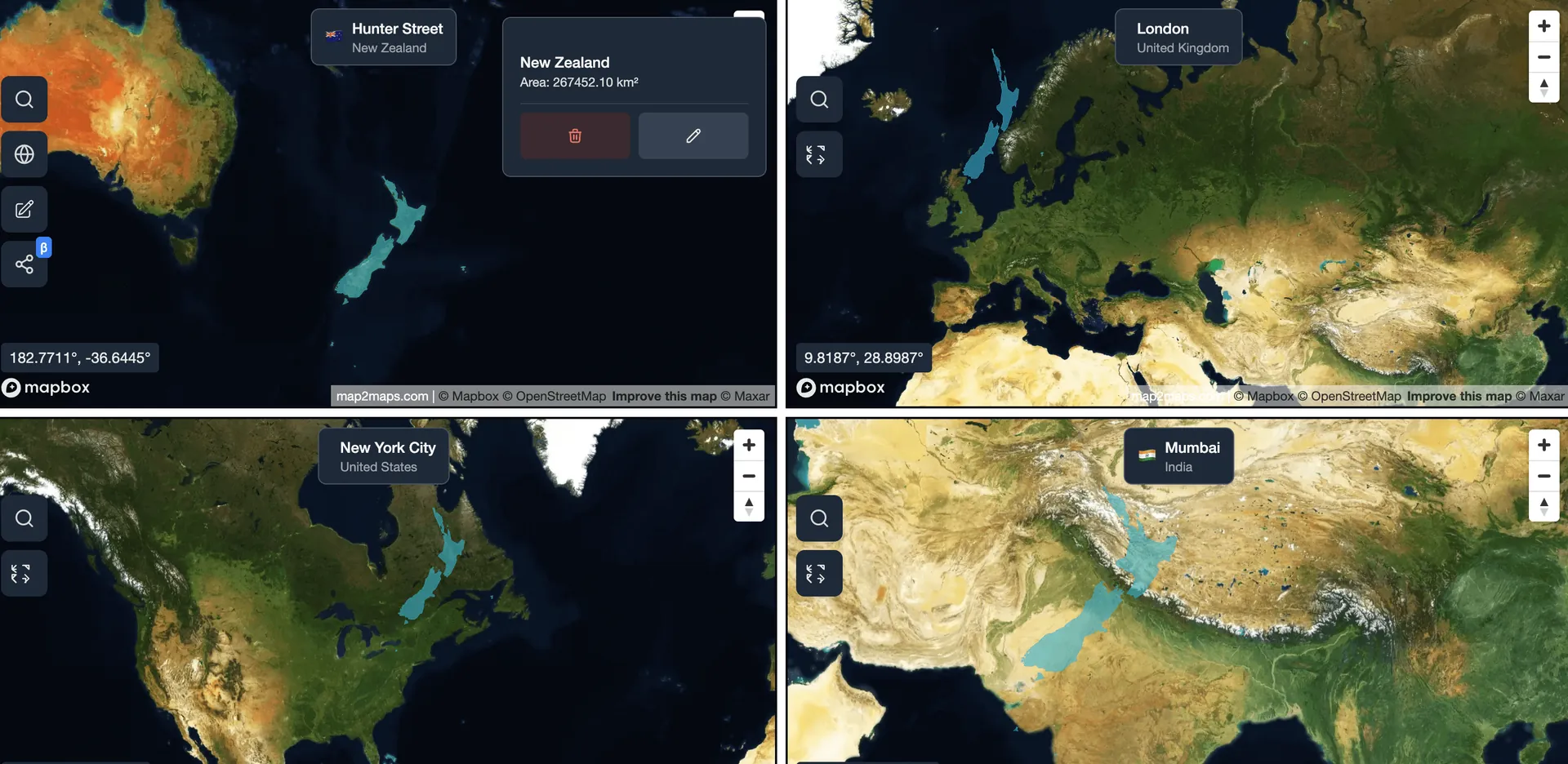
Explore for Yourself
Ready to dive deeper? Compare countries and see how Web Mercator changes their apparent size at different latitudes.
Sponsored
Products we use and recommend
Support Map2Maps by checking out these tools.
Sponsored
Send money internationally with Wise
Save up to 6x on international transfers with real exchange rates
Try WiseSponsored
Learn Languages with Langi.app
Read bite-sized stories with audio to learn languages at your level
Start LearningSponsored
Ship faster with bunny.net
Global CDN, storage, and media delivery tools that keep websites and video fast worldwide.
Explore bunny.netSponsored
Move faster with Raycast
A keyboard-first launcher with extensions, snippets, and AI to speed up everyday work.
Try RaycastSponsored
Build referral programs with Refgrow
A referral program platform for SaaS and AI products with automated tracking, commission management, and payouts.
Explore Refgrow