Central Park True Size Compared to London, Paris, and Rome
Central Park covers 3.41 km². See how that stacks up against Hyde Park in London, the historic core of Paris, and Rome's ancient center.
Map2Maps Team
Central Park is the green rectangle every visitor to New York City recognizes instantly, but how big is it really compared to the historic centers of Europe's biggest capitals?
The Numbers
- Central Park: 3.41 km² (843 acres)
- Hyde Park, London: 1.42 km² (350 acres)
- Paris 1st–4th arrondissements: 5.59 km² combined
- Rome historic district: 19.91 km²
Quick Comparison: - Central Park is more than twice the size of Hyde Park - Central Park is smaller than the combined 1st–4th arrondissements of Paris - Rome's historic district is nearly 6 times larger than Central Park
Central Park vs. Hyde Park, London
Hyde Park is one of London's largest Royal Parks, but at 1.42 km² it's noticeably smaller than Central Park. Fit Central Park into a rectangle and Hyde Park would take up less than half of it. Add neighboring Kensington Gardens (about 1.1 km²) and the combined green space still trails Central Park by a small margin.
Central Park stretches 4 km from 59th Street to 110th Street — roughly the length of 45 football fields laid end to end.
Central Park vs. Central Paris
Paris packs an enormous amount of history into a small footprint. The 1st, 2nd, 3rd, and 4th arrondissements — covering the Louvre, Les Halles, Le Marais, and Île de la Cité — together total 5.59 km², about 64% larger than Central Park. That density is part of why central Paris feels so walkable: nearly the entire historic core fits within an area you could cross on foot in under an hour.
Central Park vs. Rome's Historic Center
Rome's historic district — the area protected as a UNESCO World Heritage Site, spanning roughly from the Colosseum to the Vatican walls — covers 19.91 km². That's almost six Central Parks' worth of ancient streets, ruins, and piazzas layered with more than two thousand years of continuous history.
Why the Comparison Matters
Central Park was designed in the 1850s as a single, unified landscape — a rectangle of meadows, woodlands, and a reservoir carved directly into Manhattan's street grid. European city centers, by contrast, grew organically over centuries, so their footprints are the sum of dozens of streets, squares, and neighborhoods rather than one planned park. Comparing their areas side by side is a reminder that "big" means very different things depending on whether you're measuring a single green space or an entire historic district.
Fun Facts
- Central Park has 36 bridges and arches, none of which repeat a design.
- Hyde Park has hosted major events since 1851, when it held the Great Exhibition in the Crystal Palace.
- Paris's 4th arrondissement alone contains Notre-Dame Cathedral, the Marais, and Île Saint-Louis.
- Rome's historic center has been continuously inhabited for over 2,500 years.
Use our interactive map tool to compare countries, states, and regions by true size. For more size comparisons, see Canada vs. Europe or Japan vs. Germany.
Related Articles
Russia vs. Canada: Is Russia Really 2x Bigger?
Russia covers 17,098,242 km² against Canada's 9,984,670 km², about 71% larger — a rare case where Mercator isn't exaggerating much.
Ukraine vs. Texas: How Big is Ukraine Really?
Compare Ukraine to Texas to understand the true scale of this Eastern European nation, and why size matters in understanding geography and geopolitics.
Is Canada Bigger Than Europe? Almost, at 98% of It
Canada covers 9,984,670 km² to Europe's 10,180,000 km², so Europe is only 2% bigger. Drag Canada across Europe on our interactive map to see the overlap.
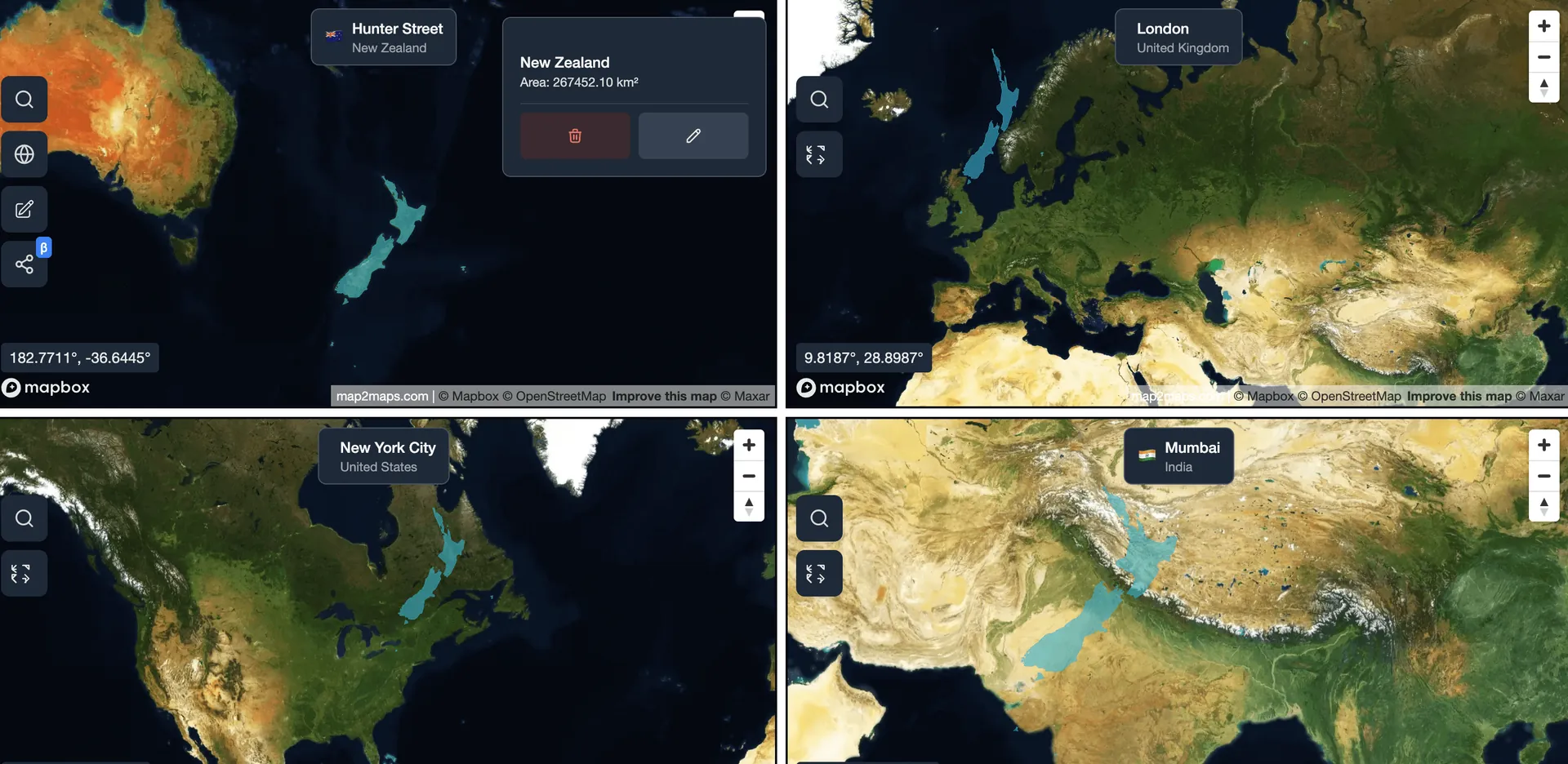
Explore for Yourself
Ready to dive deeper? Compare countries and see how Web Mercator changes their apparent size at different latitudes.
Sponsored
Products we use and recommend
Support Map2Maps by checking out these tools.
Sponsored
Send money internationally with Wise
Save up to 6x on international transfers with real exchange rates
Try WiseSponsored
Learn Languages with Langi.app
Read bite-sized stories with audio to learn languages at your level
Start LearningSponsored
Ship faster with bunny.net
Global CDN, storage, and media delivery tools that keep websites and video fast worldwide.
Explore bunny.netSponsored
Move faster with Raycast
A keyboard-first launcher with extensions, snippets, and AI to speed up everyday work.
Try RaycastSponsored
Build referral programs with Refgrow
A referral program platform for SaaS and AI products with automated tracking, commission management, and payouts.
Explore Refgrow